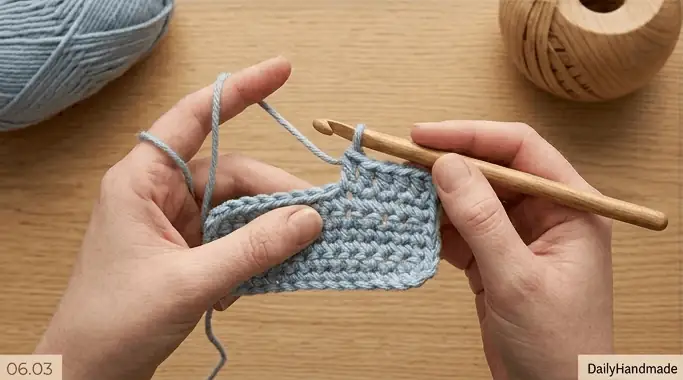
Should You Be Crocheting Into the Turning Chain? (The Gap Fix)
Quick Recognition
You’ve reached the end of your row and you see a small, vertical loop sitting slightly lower than your other stitches. It looks like a “V,” but it’s a bit tight and awkward to get your hook into. You find yourself asking: “Is this a stitch I need to work into, or just the ladder from the row below?” If you are guessing every time you reach the corner, you are likely crocheting into the turning chain when you shouldn’t—or skipping it when you should—leading to edges that either bulge out or pull too tight.
Direct Answer
Whether you should be crocheting into the turning chain depends entirely on the height of the stitch you are using. In Single Crochet (sc), the turning chain usually does not count as a stitch, so you ignore it. In Double Crochet (dc), the turning chain almost always counts as a stitch, meaning you must work your very last stitch into the top of that chain. Misapplying this rule is the #1 reason projects gain or lose width at the corners.
Why This Happens (The Turning Logic)
Mechanically, the turning chain exists to bring your hook up to the height of the next row.
- The “Double-Dip” Error: If your turning chain counts as a stitch, but you also crochet into the very first hole at its base, you’ve added a stitch.
- The “Ghost Stitch” Error: If you reach the end of a row and work into the turning chain of the row below when you aren’t supposed to, you’ve birthed an extra stitch. This structural confusion is the primary driver behind crochet widening at the end of rows, as beginners often treat every visible loop as a target for the hook.
How to Fix It (The Turn-Rule Protocol)
To master your edges and stop adding unwanted width, memorize these two industry-standard protocols:
- The SC Rule (Ignore the Chain): In Single Crochet, the ch-1 is just a lift. Do not crochet into it at the end of the next row. Your last stitch should go into the last “real” sc. See: Identifying first and last stitch
- The DC Rule (Treat it as a Stitch): In Double Crochet, the ch-3 is a “fake stitch.” You must work your last dc of the next row into the 3rd chain of that turning ladder. If you don’t, your work will shrink; if you do it plus an extra stitch, it will widen.
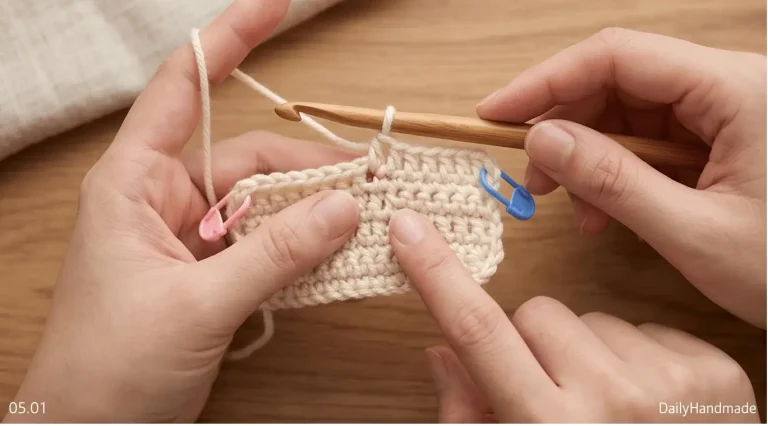
- The “Safety Marker” Trick (Expert Signal): As soon as you finish your turning chain, place a stitch marker into the top chain. When you come back across on the next row, that marker is your “Finish Line.” If there’s no marker, don’t put a stitch there. See: Using markers for straight edges
- Count Your “Posts”: Don’t just count the “Vs” on top. Count the vertical pillars (posts). If you started with 20 posts, you must end with 20 posts. If the turning chain counts as a stitch, it counts as one of those 20 pillars.
What To Expect Next
Once you apply the correct logic for your specific stitch, the “staircase” effect on your edges will disappear. Your rows will begin to stack perfectly on top of each other. You will know you’ve mastered crocheting into the turning chain when you no longer have to hesitate at the corner—you’ll see the “target” clearly and your stitch count will remain identical row after row.
Return Path
Turning chain logic is a critical component of Stage 2 “Spatial Literacy.” To see how this interacts with other mechanical errors that cause widening, return to the cluster guide: Why my crochet keeps getting wide
If your edges are straight but your project is still flaring or looking messy, explore these related diagnostics: