
Crochet Into Magic Ring First Round: Managing the Floppy Start
Quick Recognition
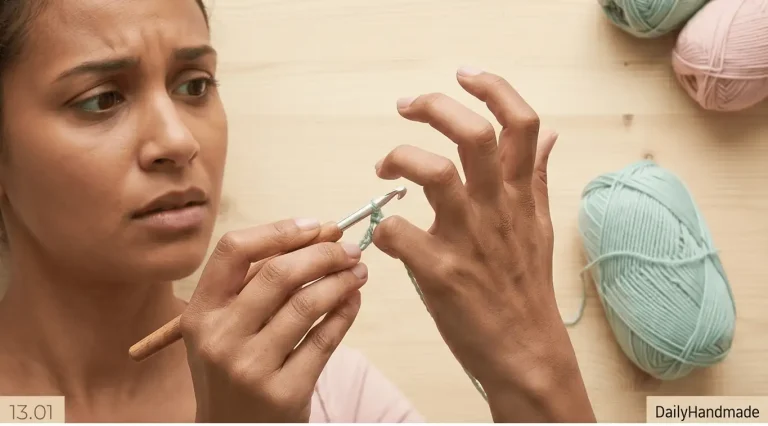
It is a quiet morning in 2026, and you’ve successfully looped your yarn into a magic circle. But as you go to make your first Single Crochet, the loop slides, twists, and feels like it’s trying to escape your fingers. You think, “How am I supposed to keep this steady enough to stitch into?” At Dailyhandmade, we recognize that the biggest hurdle in why my magic ring has a hole isn’t just the pull—it’s the prep. If your foundation stitches are sloppy, your center will never close cleanly. Learning how to crochet into magic ring first round is about creating a “tension anchor” before you ever try to cinch the hole shut.
Direct Answer
The secret to crochet into magic ring first round stability is the “Two-Strand Trap.” When you insert your hook into the ring, you must ensure you are going under both the main loop and the yarn tail. This “sandwiches” the tail inside your stitches, creating the mechanical track needed for the later cinch. In the framework, we call this Foundation Locking. Without this double-strand capture, the tail will move independently of the stitches, leading to a center that either won’t close or, worse, completely unravels later.
The Physics of the Floppy Start: Stability vs. Diameter
In the technical world of Working in the Round, we look at the Stability Factor ($S$) of your starting ring. As the Loop Diameter ($D$) increases, the stability decreases exponentially.
$$S \propto \frac{1}{D}$$
| Loop Diameter | Ease of Stitching | Risk Level |
| Small ($<2cm$) | Difficult (Too cramped). | High (Hook may split yarn). |
| Medium ($3-4cm$) | Optimal Stability. | Low (Easy to hold). |
| Large ($>5cm$) | Very Floppy. | Moderate (Stitches may twist). |
3 Strategy Drills for a Stable Foundation
If you are learning to crochet into magic ring first round in Working in the Round, use these three drills to keep your loop under control:
1. The “Pinch-and-Pivot” Grip
The loop shouldn’t hang in mid-air; it needs to be anchored to your non-hook hand.
- The Drill: Hold the “cross” (where the tail meets the loop) firmly between your thumb and middle finger. As you work each stitch, “pivot” the loop slightly to bring the next empty section under your hook. This keeps the how to pull a magic ring tight mechanics clear and untangled.
2. The “Over-Two” Verification
This is the most common failure point for beginners.
- The Drill: After every stitch, look at the base of the stitch. You should see two strands of yarn running through the bottom. If you only see one, you missed the tail. If you miss the tail, you cannot follow the flat crochet circle increase formula because your circle won’t have a center to expand from!
3. The Tension “Pre-Cinch”
Don’t wait until the end of the round to adjust the loop.
- The Drill: After you have placed 3 or 4 stitches, give the tail a tiny tug—just enough to shrink the loop diameter by about 20%. This “tightens the track” and makes it much easier to work the remaining stitches of your crochet into magic ring first round without the loop flopping around.
Dailyhandmade Expert Rescue Signal
The “Tail-End” Warning: In Why My Magic Ring Has a Hole, we always advise: “Keep your tail long!” When you are performing your crochet into magic ring first round, ensure your tail is at least 6 inches ($15cm$) long. A short tail is prone to slipping out of the stitches before you have a chance to cinch it, leading to a center that keeps opening up.
What To Expect Next
Your foundation is set, and your stitches are locked over the tail. But what happens if you pull it tight and, three rounds later, you look down and the hole has reappeared? In our next chapter of Why My Magic Ring Has a Hole, we solve the mystery of the “re-opening” center: Magic Ring Keeps Opening Up: Preventing the Center Slide.
Return Path
Mastering the crochet into magic ring first round technique is the “Setup Phase” for Working in the Round. To ensure your project starts perfectly, explore these related guides:
- Why my magic ring has a hole
- How to pull a magic ring tight
- Magic ring keeps opening up
- How to keep crochet circle round
- Master Guide: Working in the Round
I have a relevant follow-up question for you: When you work into the ring, do you find your stitches tend to “flip” upside down, or are you able to keep them standing upright along the loop?