Working in the Round Crochet for Beginners
The Skill That Unlocks Hats, Amigurumi, and Granny Squares
For many beginners, crochet feels understandable while working in rows.
You turn your work.
You see clear beginnings and endings.
Progress feels predictable.
Then working in the round appears — and suddenly crochet feels completely different.
You encounter:
- Magic Rings
- Rounds Instead Of Rows
- Evenly Spaced Increases
- Stitch Markers
- Circles That Ripple Or Fold
- Shapes Turning Into Hexagons
- Center Holes That Refuse To Close
Beginners often assume these problems mean they are doing something wrong.
Most of the time, the opposite is true.
The difficulty comes from learning the structure and mathematics of circular crochet, not from incorrect stitching.
This pillar explains how working in the round functions as a system — and why common circle problems are predictable outcomes of that system.
- Working in the Round Crochet for Beginners
- The Skill That Unlocks Hats, Amigurumi, and Granny Squares
- What “Working in the Round” Really Means
- Why Working in the Round Feels Harder
- The Three Core Round Crochet Systems
- The Working-in-the-Round Structural Framework
- System 1 — Increase Distribution
- System 2 — Shape Geometry
- System 3 — Center Stability
- The Circle Learning Model
- Why Circle Problems Are Predictable
- How This Pillar Fits Into the Crochet Learning System
- How to Use This Guide
- Why Crochet Circles Behave Differently From Rows
- The Three Most Common Beginner Circle Problems
- Why Problems Appear After “Doing Everything Right”
- The Increase Balance Principle
- Why Stitch Type Changes Circle Behavior
- The Role of Stitch Markers
- Why Magic Rings Feel Unstable at First
- Emotional Normalization: Frogging Circles Is Normal
- Mapping Problems to Learning Stages
- Transition to Structured Solutions
- The Logic Behind Flat Crochet Circles
- Why Circles Need Increases
- The Beginner Increase Formula
- Even Spacing: The Real Secret
- Why Staggering Increases Matters
- Diagnosing Circle Shape Using Geometry
- The Role of Tension in Circle Accuracy
- Adjusting Without Restarting Entire Projects
- Magic Ring Stability as Structural Foundation
- Skill Progress Recognition
- The Three Stages of Round Crochet Mastery
- Transition to Authority Expansion
- From Circle Problems to a Structured Learning System
- The Three Authority Pathways of Round Crochet
- Pathway 1 — Flatness Control
- Pathway 2 — Shape Control
- Pathway 3 — Center Stability
- How Longtails and Micros Support Learning Progression
- Tool and Material Authority Integration
- The Universal Round Crochet Workflow
- Why Understanding Geometry Accelerates Learning
- Predicting the Next Learning Transition
- The Round Geometry Triangle
- The Working-in-the-Round Navigation System
- Start Here Based on What You See
- The Beginner Round Crochet Checklist
- The Spatial Stability Threshold
- Progress Recognition: Signs You Understand Circular Crochet
- When Working in the Round Stops Feeling Difficult
- How This Pillar Maintains Spatial Authority
- How This Pillar Completes the Crochet Learning System
- System Identity: Crochet as Structured Geometry
- Continue Your Learning Path
What “Working in the Round” Really Means
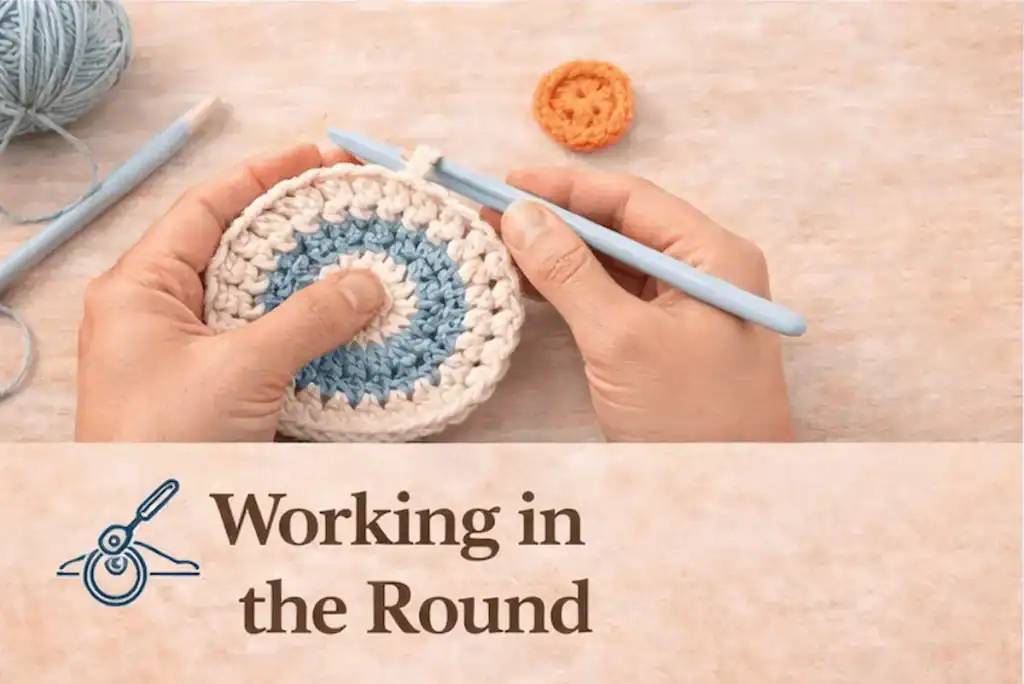
Working in the round means building fabric outward in continuous circles rather than back-and-forth rows.
Instead of turning your work, stitches expand around a center point.
This creates radial growth rather than linear growth.
Two primary methods exist.
Joined Rounds
You complete a round, join with a slip stitch, then begin the next round.
Characteristics
- Visible Round Boundaries
- Controlled Symmetry
- Easier Counting
Common Uses
- Granny Squares
- Flat Motifs
- Decorative Circles
- Structured Hats
Continuous Rounds (Spiral)
You crochet continuously without joining.
Characteristics
- No Visible Seam
- Spiral Structure
- Requires Stitch Markers
Common Uses
- Amigurumi
- Baskets
- Sculptural Projects
Authority Clarification
Patterns do not always clearly state which method is used, making early confusion normal for beginners.
Why Working in the Round Feels Harder
Row crochet relies mainly on repetition.
Round crochet introduces spatial reasoning.
Beginners must manage:
- Stitch Placement Around Curves
- Evenly Spaced Increases
- Shape Balance
- Center Tension Control
Conceptual Comparison
Rows build length.
Rounds build geometry.
Learning geometry through stitches creates a temporary increase in difficulty.
The Three Core Round Crochet Systems
The Working-in-the-Round Structural Framework
This pillar defines the official Working-in-the-Round Structural Framework used within the Crochet Hub.
All round crochet problems fall into three structural domains:
- Expansion Control
- Geometric Distribution
- Center Foundation Stability
Every circle distortion, polygon shape, or center hole can be traced back to one of these domains.
This framework replaces guesswork with structural diagnosis.
Instead of asking “Why does this look wrong?” beginners learn to ask:
Which structural domain is unstable?
Nearly all beginner round problems belong to three structural systems:
- Increase Distribution — Controls Flatness
- Shape Geometry — Controls Roundness
- Center Stability — Controls Magic Ring Closure
These systems form the foundation of this pillar.
System 1 — Increase Distribution
Circles grow because stitches increase each round.
If increases are incorrect:
- Too Many → Circle Becomes Wavy
- Too Few → Circle Cups Like A Bowl
Flat circles require mathematical balance rather than guesswork.
System 2 — Shape Geometry
Even with correct increase counts, placement matters.
If increases stack in identical positions each round, edges form corners instead of curves.
This produces hexagon-like shapes.
Roundness depends on distribution, not just quantity.
System 3 — Center Stability
The starting point of the circle determines long-term structure.
Magic rings concentrate stress at a single adjustable loop.
If unsecured:
- Holes Appear
- Rings Loosen
- Projects Weaken Over Time
Center stability is therefore structural, not cosmetic.
The Circle Learning Model
Beginner progression in round crochet typically follows this sequence:
- Learn Magic Ring
- Understand Increase Formula
- Correct Waviness
- Fix Polygon Shapes
- Stabilize Centers
Problems appear in this order because each stage reveals deeper structural understanding.
Predictive Insight
Most beginners encounter magic ring frustration before circle-shape problems because center control develops first.
Why Circle Problems Are Predictable
Circular crochet follows geometric rules.
Each stitch height determines how fast the circle expands.
Example
- Single Crochet Grows Slowly
- Double Crochet Grows Faster
- Taller Stitches Require More Increases
When increases do not match stitch height, distortion appears automatically.
Authority Insight
Crochet circles fail mathematically before they fail technically.
Understanding this removes the feeling of randomness.
How This Pillar Fits Into the Crochet Learning System
Within the Crochet Hub:
- Stitch Pillars Teach Execution
- Troubleshooting Pillars Teach Correction
- Project Pillars Teach Application
- This Pillar Teaches Spatial Construction
It prepares learners for three major crochet categories:
- Amigurumi
- Hats
- Motif-Based Designs
This pillar governs three longtail authority guides:
Each expands one structural system introduced here.
How to Use This Guide
Start based on what you see in your work:
- Ripples Or Ruffles → Increase Distribution Issue
- Flat Sides Or Corners → Increase Placement Issue
- Center Hole → Magic Ring Stability Issue
Predictive Guidance
Nearly every round crochet problem becomes solvable once learners understand that circles obey consistent rules.
Working in the round becomes easier when shapes feel logical instead of mysterious.
Why Crochet Circles Behave Differently From Rows
When beginners first try working in the round, they often expect circles to behave like rows arranged in a loop.
But circular crochet follows different structural rules.
In rows, each new line builds forward in a straight direction.
In rounds, every stitch pushes outward from a center point. This creates expansion pressure across the entire fabric.
Because of this outward growth, even small inconsistencies multiply quickly.
A single extra increase affects the entire circumference rather than one edge.
This is why circle problems appear dramatic even when mistakes are small.
The Three Most Common Beginner Circle Problems
Nearly every beginner issue when working in the round belongs to one of three visual categories.
Recognizing the category is the first step toward fixing it.
1. Wavy or Ruffled Circles
The circle develops ripples or a “lettuce edge.”
Typical Appearance
- Edges Lift Upward
- Fabric Refuses To Lie Flat
- Waves Increase With Each Round
This happens when the circle grows faster than it should.
The most common cause is too many increases.
Predictive Insight
Waviness usually appears after several rounds, not immediately, because expansion imbalance accumulates gradually.
2. Hexagon or Polygon Shapes
Instead of smooth curves, the circle forms visible sides or corners.
Beginners describe shapes resembling:
- Hexagons
- Stop Signs
- Flattened Edges
This occurs when increases repeat in the same positions every round.
The circle grows evenly in count but unevenly in distribution.
Conceptual Clarification
A hexagon is mathematically stable — meaning the crochet is structured correctly but arranged predictably rather than smoothly.
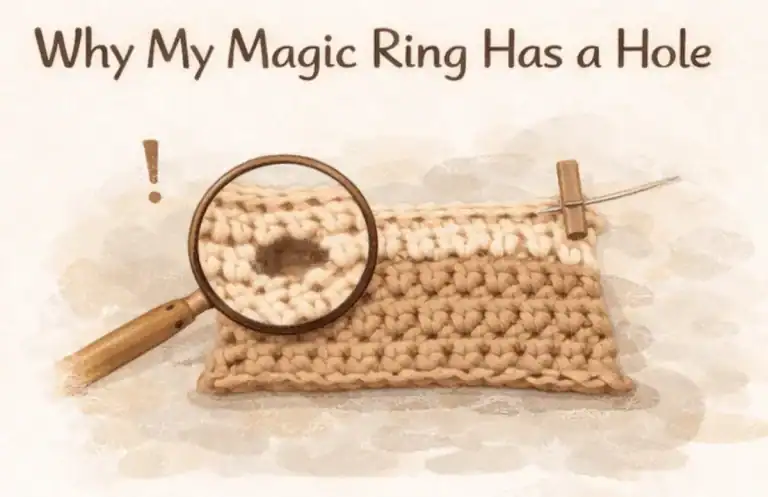
3. Center Holes or Loose Magic Rings
The project begins correctly but develops a visible hole at the center.
Common Signs Include
- Adjustable Loop Loosening
- Center Widening After Handling
- Tail Slipping Over Time
This problem originates from insufficient center stabilization rather than incorrect stitching.
Authority Insight
The first stitches of a project carry the highest structural tension.
Why Problems Appear After “Doing Everything Right”
Many beginners follow patterns exactly yet still encounter shape issues.
This happens because patterns assume consistent tension and spacing.
Small differences in:
- Hook Pressure
- Yarn Thickness
- Stitch Height
- Personal Tension
change how expansion behaves.
Crochet patterns provide formulas, but execution introduces variation.
Applicability Boundary
Two crocheters following identical instructions may produce slightly different circle behavior due to individual tension styles.
The Increase Balance Principle
A flat circle requires balance between three variables:
- Stitch Height
- Increase Frequency
- Tension Consistency
If any variable shifts, shape distortion appears.
| Imbalance | Result |
|---|---|
| Too Many Increases | Waviness |
| Too Few Increases | Cupping |
| Stacked Increases | Polygon Shape |
| Loose Center Tension | Hole |
Understanding this balance simplifies troubleshooting dramatically.
Why Stitch Type Changes Circle Behavior
Different stitches expand at different rates.
Short stitches require fewer increases.
Tall stitches require more.
Examples
- Single Crochet → Slow Expansion
- Half Double Crochet → Moderate Expansion
- Double Crochet → Faster Expansion
Beginners often apply one increase pattern across stitch types, creating distortion unintentionally.
Authority Clarification
Increase formulas are not universal; they depend on stitch height.
The Role of Stitch Markers
In round crochet, stitch markers function as navigation tools.
Without turning rows, the beginning of the round becomes difficult to identify.
Common Beginner Errors Without Markers
- Accidental Extra Stitches
- Missed Increases
- Drifting Stitch Counts
Markers reduce cognitive load, allowing focus on spacing and rhythm.
Predictive Guidance
Many shape problems disappear simply by tracking the start of each round consistently.
Why Magic Rings Feel Unstable at First
Magic rings challenge beginners because the foundation is adjustable.
Unlike chain starts, the structure tightens only after stitches are formed.
Early rounds may feel loose or fragile.
This instability is temporary and improves once:
- The Tail Is Tightened Fully
- Stitches Distribute Tension Evenly
- The Tail Is Secured Properly
Failure Anticipation
Beginners often move forward before tightening the ring completely, allowing gaps to remain permanently.
Emotional Normalization: Frogging Circles Is Normal
Circular crochet frequently requires restarting.
Even experienced crocheters redo early rounds to correct spacing or tension.
This happens because small early adjustments affect all later rounds.
Restarting early saves effort later.
Authority Insight
Frogging circles is not failure; it is part of precision shaping.
Mapping Problems to Learning Stages
| Learning Stage | Common Problem |
|---|---|
| First Rounds | Magic Ring Difficulty |
| Early Circles | Waviness |
| Mid Rounds | Polygon Shapes |
| Larger Circles | Tension Variation |
Recognizing this progression helps beginners anticipate challenges instead of feeling surprised by them.
Transition to Structured Solutions
Now that the problem landscape is clear, the next step is understanding how flat circles are intentionally constructed.
The following section explains the increase formulas and spacing logic that create balanced circles — and how small adjustments restore shape control.
The Logic Behind Flat Crochet Circles
Flat circles are not created by intuition alone.
They follow a predictable structural rule known as the increase formula.
Once beginners understand this formula, most round crochet problems become easier to diagnose and fix.
Instead of guessing where to add stitches, you begin controlling how the circle grows.
Why Circles Need Increases
Each round travels a larger distance than the one before it.
Because circumference expands outward, additional stitches are required to prevent the fabric from pulling inward.
Without increases:
- The Circle Cups Into A Bowl
With too many increases:
- The Circle Ripples Outward
The correct number creates balance.
Conceptual Comparison
A circle behaves like adding lanes to a growing road — more distance requires more space.
The Beginner Increase Formula
Most crochet circles follow a repeating mathematical pattern.
Single Crochet Circle (Classic Formula)
A standard single crochet circle uses 6 increases per round.
Example Structure
- Round 1: 6 Stitches
- Round 2: Increase In Each Stitch (12)
- Round 3: (1 SC, Increase) Repeat (18)
- Round 4: (2 SC, Increase) Repeat (24)
- Round 5: (3 SC, Increase) Repeat (30)
Each round adds one more regular stitch between increases.
Authority Insight
This pattern appears in countless projects because it maintains geometric balance.
Double Crochet Circle Formula
Double crochet stitches are taller and expand faster.
Therefore, they usually require 12 increases per round.
This explains why double crochet circles become wavy more easily when increases are miscounted.
Applicability Boundary
Different designers may vary slightly, but the expansion principle remains consistent.
Even Spacing: The Real Secret
Beginners often focus on increase numbers but overlook spacing.
Even spacing distributes expansion smoothly around the circle.
Uneven spacing concentrates growth in certain areas, creating distortion.
Correct Spacing Produces
- Smooth Edges
- Balanced Growth
- Predictable Shaping
Predictive Insight
Many “mystery” circle problems originate from uneven increase spacing rather than incorrect counts.
Why Staggering Increases Matters
If increases occur in identical positions each round, corners form naturally.
This creates polygon shapes such as hexagons.
Staggering Explained
Staggering means shifting increase placement slightly each round.
Instead of stacking increases vertically, they move sideways across rounds.
Result
- Smoother Curves
- Reduced Corner Formation
- Visually Round Shapes
Authority Clarification
Staggering does not change stitch count — only distribution.
Diagnosing Circle Shape Using Geometry
You can diagnose circle issues visually.
| Shape | Diagnosis | Adjustment |
|---|---|---|
| Wavy Edge | Too Many Increases | Reduce Increases |
| Bowl Shape | Too Few Increases | Add Increases |
| Hexagon | Stacked Increases | Stagger Placement |
| Center Hole | Loose Start | Tighten Ring |
Learning visual diagnosis accelerates correction.
The Role of Tension in Circle Accuracy
Even with correct formulas, tension influences outcome.
Loose tension expands stitch width, mimicking extra increases.
Tight tension compresses stitches, mimicking too few increases.
This explains why two crocheters using identical patterns may produce slightly different shapes.
Authority Insight
Patterns provide mathematical guidance; tension provides execution balance.
Adjusting Without Restarting Entire Projects
Small corrections can stabilize circles mid-project.
Beginner Adjustments Include
- Skipping One Planned Increase
- Adding One Corrective Increase
- Switching Hook Size Slightly
- Tightening Or Relaxing Tension Consciously
Failure Anticipation
Large distortions usually require restarting early rounds, but minor waviness often resolves with small corrections.
Magic Ring Stability as Structural Foundation
The center determines long-term durability.
To Stabilize a Magic Ring
- Complete First Round Evenly
- Pull Tail Firmly
- Secure Tail Through Stitches
- Weave In Securely
If the center loosens later, structural stress spreads outward.
Conceptual Clarification
A stable center distributes tension evenly across the circle.
Skill Progress Recognition
The Three Stages of Round Crochet Mastery
Within the Crochet Hub progression, working in the round develops in three stages:
Stage 1 — Formula Execution
Beginners follow increase counts carefully.
Stage 2 — Visual Diagnosis
Beginners identify waviness, cupping, or corners quickly.
Stage 3 — Structural Creativity
Crocheters modify increase distribution intentionally to shape three-dimensional forms.
Progression Insight
Progression shifts round crochet from counting to construction thinking.
You are improving in round crochet when:
- Increases Feel Predictable
- Stitch Counting Becomes Automatic
- Circles Lie Flat Without Adjustment
- Magic Rings Close Consistently
At this stage, circles shift from confusing shapes to controllable structures.
Transition to Authority Expansion
Now that the construction logic is clear, the next section connects circle shaping and magic ring troubleshooting to the broader Crochet Hub authority structure.
You will see how waviness, polygon shapes, and center holes expand into dedicated longtail guides and micro solutions designed for specific beginner problems.
From Circle Problems to a Structured Learning System
Many beginners search for solutions using isolated questions:
- Why Is My Crochet Circle Wavy?
- Why Does My Circle Look Like A Hexagon?
- Why Won’t My Magic Ring Close?
While each question seems separate, they are actually connected parts of one structural system: working in the round geometry.
This pillar expands those individual problems into a unified authority framework where each symptom leads to a clear learning pathway.
Instead of memorizing fixes, learners understand how circular crochet behaves.
The Three Authority Pathways of Round Crochet
All beginner round-crochet troubleshooting inside the Crochet Hub develops through three interconnected pathways:
- Flatness Control (Increase Balance)
- Shape Control (Increase Placement)
- Center Stability (Magic Ring Structure)
Each pathway expands into a dedicated longtail guide supported by focused micro solutions.
The pillar defines the system.
Longtails explain the concepts.
Micros resolve specific situations.
Pathway 1 — Flatness Control
(Why My Crochet Circle Is Wavy)
Flatness problems appear when expansion speed exceeds structural balance.
Typical Symptoms
- Rippling Edges
- Ruffles Forming After Several Rounds
- Circles Refusing To Lie Flat
Core Learning Concepts Include
- Increase Formulas
- Stitch Height Influence
- Tension Interaction
- Spacing Consistency
Micro Guides Address
- Too Many Increases
- Ripple Formation After Multiple Rounds
- Correcting Waviness
- Yarn Selection For Stable Circles
- Blocking Expectations
Authority Insight
Flatness is governed primarily by mathematics rather than technique difficulty.
Once increase logic is understood, waviness becomes predictable and preventable.
Pathway 2 — Shape Control
(Why Crochet Circle Turns Into a Hexagon)
Shape distortion occurs even when stitch counts are correct.
This pathway explains distribution rather than quantity.
Common Symptoms
- Flat Sides
- Visible Corners
- Stop-Sign Shapes
Learning Outcomes Include
- Staggering Increases
- Spacing Adjustments
- Stitch-Type Expansion Differences
- Recognizing Geometric Patterns In Crochet
Micro Guides Explore
- Where Increases Should Be Placed
- How Many Increases Per Round
- Identifying Stacked Increases
- Understanding Stitch Height Effects
Authority Clarification
Polygon shapes indicate structural regularity, not failure — the circle is mathematically consistent but visually segmented.
Pathway 3 — Center Stability
(Why My Magic Ring Has a Hole)
Center problems originate at the starting point of round crochet.
Because all tension radiates outward from the center, instability here affects the entire project.
Key Concepts Include
- Tightening Sequence
- Tail Security
- Yarn Friction Differences
- Alternative Starting Methods
Micro Guides Solve
- Closing Magic Rings Fully
- Crocheting First Rounds Securely
- Preventing Loosening Over Time
- Choosing Beginner-Friendly Alternatives
Applicability Boundary
Magic rings are helpful but not mandatory. Chain-circle starts remain valid beginner solutions.
How Longtails and Micros Support Learning Progression
The DH248 learning architecture distributes complexity intentionally.
| Content Level | Role |
|---|---|
| Pillar | Explains Round Crochet System |
| Longtail | Teaches Structural Concept |
| Micro | Solves Specific Symptom |
Example Progression
Wavy Circle → Micro Explanation → Longtail Increase Theory → Pillar Reinforces Geometry Understanding
This layered approach prevents overwhelm while maintaining authority depth.
Tool and Material Authority Integration
Working in the round is highly sensitive to tool choice.
Certain tools reduce beginner friction:
- Medium-Sized Hooks Improve Control
- Smooth Yarn Reveals Stitch Placement
- Stitch Markers Prevent Counting Errors
Supporting Buying Guides
Authority Insight
Tool clarity improves spatial understanding, accelerating mastery of circular construction.
The Universal Round Crochet Workflow
Across all round projects, a consistent diagnostic sequence applies:
Step 1 — Check Stitch Count
Confirm increase formula accuracy.
Step 2 — Check Increase Placement
Ensure increases are staggered.
Step 3 — Check Center Stability
Verify magic ring closure.
Step 4 — Evaluate Tension
Adjust only if structure is correct.
Following this order resolves most circle problems efficiently.
Why Understanding Geometry Accelerates Learning
Before understanding geometry:
Problem → Guess → Restart → Frustration
After understanding geometry:
Problem → Identify System → Adjust → Continue
Understanding reduces uncertainty, which increases confidence.
Each successful circle strengthens spatial intuition used in hats, amigurumi, and motifs.
Predicting the Next Learning Transition
After mastering working in the round, beginners typically notice a shift:
They begin modifying patterns confidently.
Instead of asking:
“How does this shape look wrong?”
they ask:
“How should I adjust increases for this design?”
This marks the transition from beginner execution to structural creativity.
The Round Geometry Triangle
Expansion, Placement, and Foundation form a structural triangle.
- If Expansion Exceeds Balance → Waviness Appears
- If Placement Repeats → Corners Form
- If Foundation Loosens → Center Distortion Spreads Outward
Understanding this triangle connects all circle troubleshooting into one unified system.
The three longtail guides expand each side of this triangle while this pillar preserves system clarity.
The Working-in-the-Round Navigation System
Working in the round becomes easier once circle behavior feels predictable.
This pillar functions as the spatial construction guide within the Crochet learning system.
Instead of treating circle problems as isolated mistakes, it helps beginners identify which structural system is responsible and where to go next.
You do not need to memorize formulas immediately.
You only need to recognize what your crochet is showing you.
Start Here Based on What You See
Use this diagnostic navigation whenever a round project behaves unexpectedly.
If Your Circle Is Wavy or Ruffled
Begin with increase balance.
Go to:
Focus On
- Increase Frequency
- Stitch Height Relationships
- Tension Interaction
- Correcting Expansion Speed
Predictive Insight
Most waviness results from slightly excessive increases rather than incorrect stitching.
If Your Circle Looks Like a Hexagon
Focus on increase placement.
Go to:
Why Crochet Circle Turns Into a Hexagon
You Will Learn
- Staggering Increases
- Distributing Growth Evenly
- Recognizing Geometric Patterns
- Smoothing Circle Edges
Understanding placement transforms polygon shapes into smooth curves.
If Your Magic Ring Has a Hole
Start with center stabilization.
Go to:
This Pathway Explains
- Tightening Techniques
- Securing Yarn Tails
- Preventing Loosening Over Time
- Beginner-Friendly Alternatives
Authority Insight
A stable center prevents many future structural issues.
The Beginner Round Crochet Checklist
Whenever a round project feels wrong, follow this sequence:
1. Count Stitches
Confirm increase totals.
2. Check Increase Spacing
Avoid stacking increases.
3. Tighten the Center
Stabilize the magic ring early.
4. Evaluate Tension Last
Structure matters before adjustment.
This order prevents unnecessary restarts.
The Spatial Stability Threshold
Spatial stability appears when circles lie flat without mid-project adjustment.
Signs Include
- Consistent Increase Rhythm
- Automatic Stagger Placement
- Minimal Need For Stitch Markers
- Predictable Expansion Behavior
This threshold marks the transition from beginner counting to geometric intuition.
Progress Recognition: Signs You Understand Circular Crochet
You are advancing when:
- Circles Lie Flat Consistently
- Increase Patterns Feel Logical
- Stitch Markers Become Optional Rather Than Essential
- Magic Rings Close Confidently
- Shapes Match Pattern Expectations More Often
Resolution Confirmation
When you can predict how a circle will behave before finishing a round, spatial understanding has begun to develop.
When Working in the Round Stops Feeling Difficult
At first, circular crochet requires conscious counting and monitoring.
Later, rhythm replaces calculation.
You may notice yourself:
- Recognizing Increase Patterns Automatically
- Adjusting Placement Instinctively
- Detecting Shape Imbalance Early
- Modifying Rounds Without Hesitation
This transition marks the development of crochet spatial intuition.
Applicability Boundary
Even experienced crocheters occasionally restart early rounds. Precision at the center always influences final results.
How This Pillar Maintains Spatial Authority
All working-in-the-round questions inside the Crochet Hub route through this framework.
Micro guides address specific distortions.
Longtail guides explain structural geometry.
This pillar maintains system-level clarity for circular construction.
Every future round-based project connects back to these three structural domains.
How This Pillar Completes the Crochet Learning System
Within the Crochet Hub architecture:
- Early Pillars Teach Tools And Stitches
- Troubleshooting Pillars Teach Diagnosis
- Care Pillars Teach Preservation
- This Pillar Teaches Spatial Construction
It prepares learners for advanced crochet categories including:
- Amigurumi Shaping
- Hats And Garments
- Motif-Based Designs
- Three-Dimensional Crochet Structures
Working in the round represents one of the final foundational skills before creative independence.
System Identity: Crochet as Structured Geometry
Crochet is often introduced as a relaxing craft, but working in the round reveals a deeper truth:
Crochet is applied geometry expressed through yarn.
Each stitch contributes to spatial balance.
Understanding this transforms crochet from imitation into intentional construction.
Mistakes become signals, not obstacles.
Continue Your Learning Path
After mastering working in the round, continue strengthening your crochet system through related pillars:
Or explore longtail and micro guides whenever a specific circle problem appears.
Every round project now connects to a predictable learning pathway.