
Crochet Hook Too Big? What Happens and How to Spot It
Quick Recognition
You’ve heard that beginners should use a larger hook to make it “easier” to see the stitches. So, you grabbed a chunky 8mm or 10mm hook for your standard worsted weight yarn. At first, it’s great—the hook slides in effortlessly! But as your project grows, it starts to look like a fishing net. There are massive holes where there should be solid fabric, and your scarf feels more like a wet noodle than a cozy accessory. If your work looks “holey” and lacks any kind of shape, you’re experiencing the symptoms of crochet hook too big what happens.
Direct Answer
When your crochet hook is too big for the yarn, the result is oversized, loose stitches with excessive “negative space” (gaps) between them. In the Master Guide: Crochet Hooks & Tools framework, we teach that the yarn simply cannot “fill” the loop created by a massive hook. This leads to a fabric that is floppy, lacks structure, and fails to hold its shape. While a slightly larger hook is good for “drape,” a hook that is too big turns your stitches into a disorganized mess.
The Technical “Giant Hook” Audit
At Dailyhandmade, we’ve seen many beginners choose a large hook thinking it will be “faster.” Here is what actually happens to your Longtail #12 project:
1. The “Swiss Cheese” Effect
Because the hook head is so wide, it stretches the yarn loop far beyond its natural diameter. When you finish the stitch, the yarn “relaxes,” but the hole remains huge. This is particularly bad for Amigurumi (stuffed toys) because the stuffing will leak out through the gaps.
2. Loss of Definition
In Pillar #04, we talked about “Stitch Definition.” When a hook is too big, the “V” on top of the stitch becomes elongated and messy. It becomes harder to tell where one stitch ends and the next begins because everything is just a blurry, loose loop.
3. The “Growing” Project
Oversized hooks create oversized stitches. Your 10cm wide scarf might suddenly become 15cm wide because the stitches are “blooming” outward. You’ll run out of yarn much faster than the pattern intended.
Comparison Table: Just Right vs. Too Big
| Feature | The “Goldilocks” Fit | The “Too Big” Fit |
| Visual Texture | Solid, even, and consistent. | Lacy, gappy, and thin. |
| Structure | Holds its shape (e.g., a square stays square). | Floppy/Droopy; stretches out of shape. |
| Stitch “V” | Crisp and easy to count. | Large, distorted, and messy. |
| Yarn Usage | Follows pattern estimates. | Guzzles yarn (runs out early). |
How to Spot It (The “Transparency Test”)
Before you finish another row of your Master Guide: Crochet Hooks & Tools practice piece, try this:
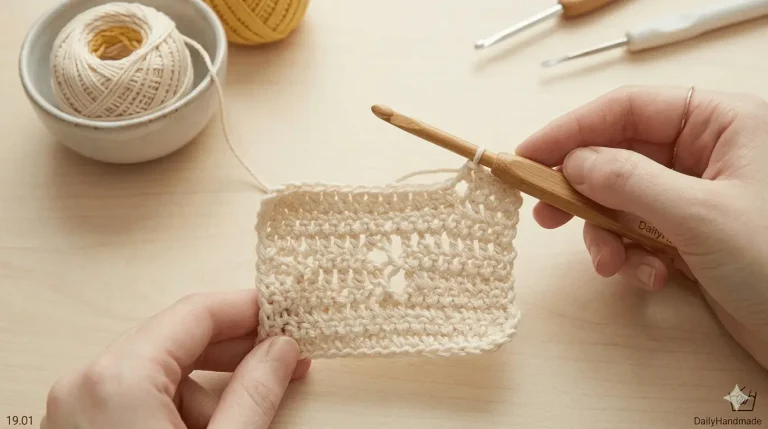
- The Light Test: Hold your work up to a window or a lamp. If you can see huge amounts of light through every single stitch, your crochet hook is too big.
- The Poke Test: Try to poke your pinky finger through a stitch. In standard worsted weight crochet, your finger shouldn’t easily slide through. If it does, your hook is likely 1-2 sizes too large.
- The Drape Check: Pick up the piece by one corner. If it collapses immediately like a piece of silk (when it should be a sturdy wool), you’ve over-sized your hook.
Dailyhandmade Expert Tip: Sometimes, a hook that is “too big” is an intentional choice for Lace or Beach cover-ups. But if you’re trying to learn the basics, a giant hook is your enemy because it hides the mistakes you should be seeing.
What To Expect Next
Now that you know the dangers of both “Too Small” and “Too Big,” you’re probably wondering: “Why doesn’t the yarn label just tell me the perfect size?” It does—but it’s not always the full story. Let’s look at the “hidden secrets” of the yarn label.
Return Path
Identifying the “Giant Hook” trap is essential for your What Size Crochet Hook Should Beginners Use journey. To perfect your toolkit, dive into these next steps: