
Crochet Chart vs Written Pattern Differences: Why They Don’t Match
Quick Recognition
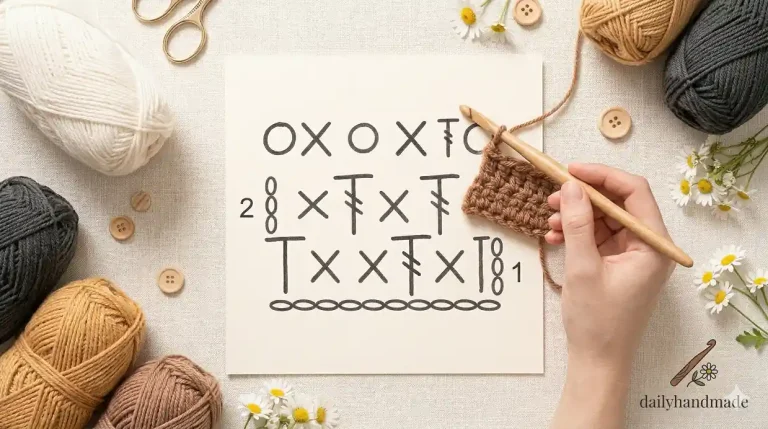
It is a breezy afternoon in April 2026, and you are deep into a project, switching between the text and the visual map. You’ve already mastered basic crochet diagram symbols explained, but suddenly you hit a wall. The written pattern says “Row 5: 12 dc,” but you count 14 symbols on the chart. You think, “Did I misread the map, or is the text lying to me? Why are there so many crochet chart vs written pattern differences?” At Dailyhandmade, we call this the “Abstraction Gap.” In How to Read Crochet Patterns, we teach you that a chart and a written pattern are two different languages trying to describe the same 3D object—and sometimes, things get lost in translation.
Direct Answer
The primary reason for crochet chart vs written pattern differences is the conflict between Spatial Representation and Sequential Logic. A chart shows you exactly where a stitch sits in space, whereas written text describes the action of making it. Discrepancies often arise from human error during transcription, differences in how “turning chains” are counted, or the designer’s attempt to simplify a complex visual repeat into words. In the framework, when in doubt, we usually trust the Chart, as it is a literal drawing of the finished fabric.
The Science of Fidelity: The Abstraction Gap
In the technical world of How to Read Crochet Patterns, we analyze Information Fidelity ($I_f$). This measures how accurately the instruction reflects the physical reality of the stitch.
$$I_f = \frac{\text{Spatial Clarity (Chart)}}{\text{Semantic Precision (Text)}}$$
| Feature | Written Pattern (Text) | Crochet Chart (Diagram) |
| Primary Logic | Temporal (What to do next). | Spatial (Where to put it). |
| Common Error | Typos in stitch counts. | Misplaced symbols. |
| Turning Chains | Often excluded from counts. | Always visible as symbols. |
| Complexity | Becomes a “wall of text.” | Remains a clear, visual map. |
3 Strategy Drills to Resolve Discrepancies
If you are facing crochet chart vs written pattern differences in How to Read Crochet Patterns, run your project through these three “Truth Tests”:
1. The “Turning Chain” Audit
This is the #1 cause of count mismatches.
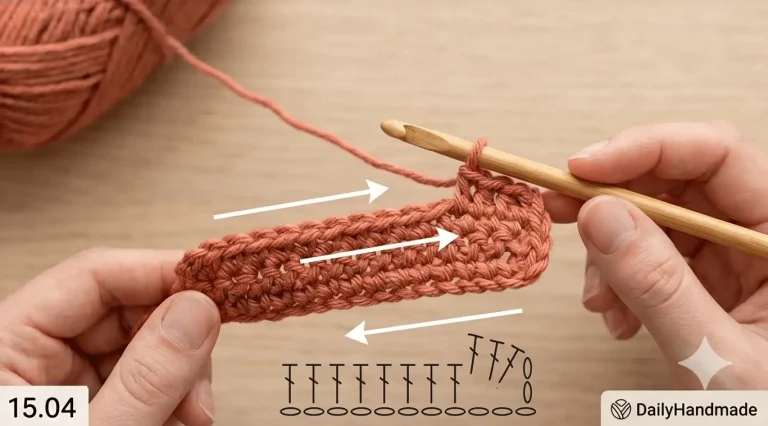
- The Drill: Look at the chart. Does the turning chain count as a stitch (represented by a vertical stack of ovals)? Now look at the written text. Does it say “Ch 3 (counts as first dc)”? If one counts it and the other doesn’t, your total stitch count will be off by one. This is a foundational part of understanding crochet chart diagrams for beginners.
2. The “Repeated Unit” Verification
Text often summarizes, while charts visualize.
- The Drill: Check the “repeat” brackets in the text (e.g.,
*dc 2, ch 1*). Then, count the symbols within one repeat on the chart. If the text says “Repeat 5 times” but the chart shows 6 repeats to fill the row, the chart is usually correct because it must fit the physical width of the how to read crochet diagrams in rows logic.
3. The “Visual Anchor” Match
Symbols provide a 1:1 relationship that words cannot.
- The Drill: Pick a prominent “anchor” stitch, like a shell or a cluster. Find it in the text and find it on the chart. If the text says it should be in the 5th stitch but the chart shows it in the 4th, look at the row below. The chart shows exactly which “hole” the stitch enters. Trust the picture over the number—spatial logic is harder to “fudge” than a typo.
Dailyhandmade Expert Rescue Signal
The “Global Designer” Warning: In How to Read Crochet Charts (Diagram Symbols for Beginners), we remind you that many patterns are translated from other languages. While the words might get garbled in a translation app, the symbols are universal. If you are working on a pattern with crochet chart vs written pattern differences from an international designer, the chart is almost 100% the more reliable source.
What To Expect Next
You’ve decided to trust the chart, but you find that you still prefer having written instructions to “check off” as you go. What if the pattern only has a chart? Can you write your own text? In our next chapter of How to Read Crochet Charts (Diagram Symbols for Beginners), we learn the skill of the “Reverse Engineer”: How to Convert Crochet Charts to Written Instructions: A Step-by-Step.
Return Path
Understanding crochet chart vs written pattern differences is a high-level “Critical Thinking” skill in How to Read Crochet Patterns. To keep your project on track, explore these related guides:
- Understanding crochet chart diagrams for beginners
- Basic crochet diagram symbols explained
- How to read crochet diagrams in the round
- Common crochet chart reading mistakes
- Master Guide: How to Read Crochet Patterns
I have a relevant follow-up question for you: When you run into a discrepancy, do you usually feel more comfortable counting the symbols on the paper, or re-reading the written row three times to see if you missed a comma?