Common Crochet Chart Reading Mistakes: How to Stay on Track
Quick Recognition
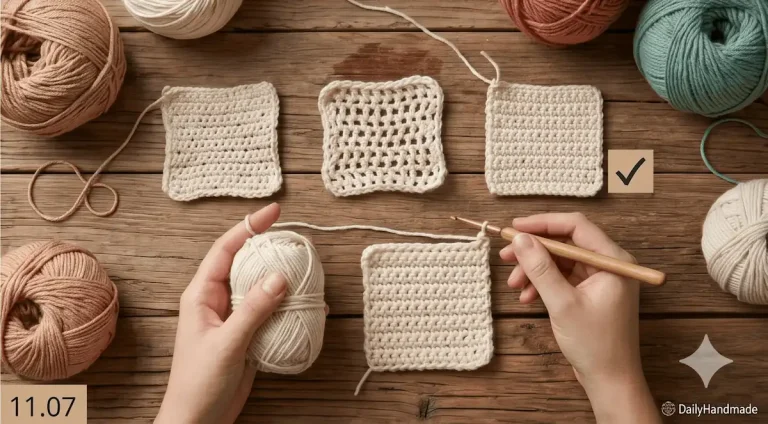
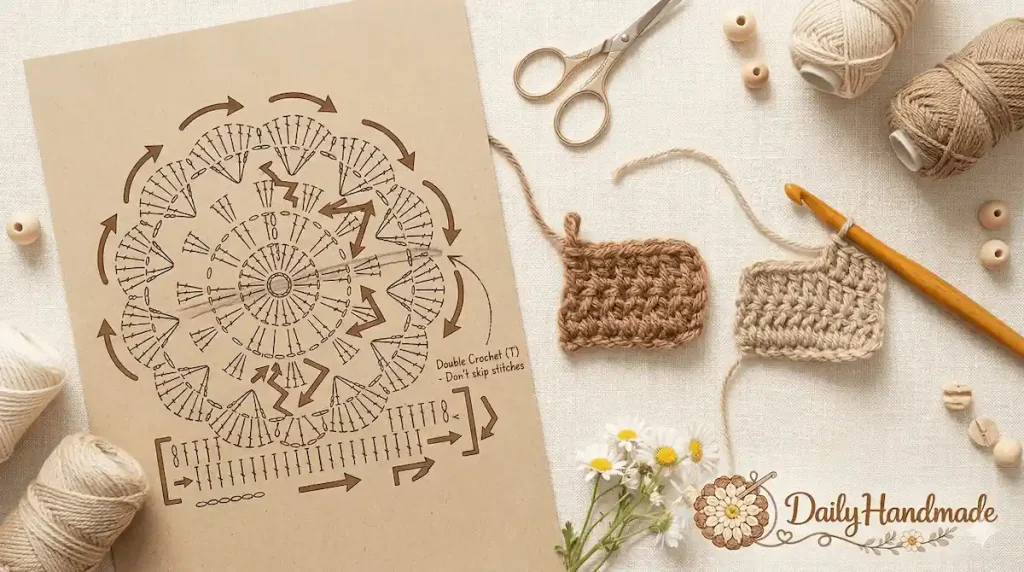
It is a breezy afternoon in April 2026, and you’ve been diligently following a beautiful floral diagram. You’ve mastered the basic crochet diagram symbols explained, yet as you hold up your work, it looks like a leaning tower instead of a perfect square. You think, “I followed the symbols perfectly, so why is my edge shrinking? What are these common crochet chart reading mistakes everyone talks about?” At Dailyhandmade, we view a chart as a living document. In How to Read Crochet Patterns, we teach that reading a chart isn’t just about identifying stitches—it’s about understanding the spatial “rhythm” of the design.
Direct Answer
Most common crochet chart reading mistakes stem from three specific errors: Directional Misalignment (reading every row from left-to-right), Turning Chain Neglect (forgetting that the vertical ovals at the edge count as a stitch), and Repeat Boundary Overlap (misinterpreting where a pattern section begins and ends). In the framework, we use a “Visual Audit” to catch these errors before they require hours of “frogging” (ripping out) your yarn.
The Science of Visual Drift: The Error Margin ($E_m$)
In the technical world of How to Read Crochet Patterns, we calculate the Error Margin ($E_m$) based on the number of stitches ($s$) and the frequency of pattern repeats ($r$).
$$E_m = \frac{\Delta s}{r}$$
Where $\Delta s$ is the difference between symbols on the paper and stitches on your hook.
| The Mistake | The Scientific Reason | The Dailyhandmade Fix |
| Mirroring the Work | Reading the WS from the wrong side. | Follow how to read crochet diagrams in rows. |
| The Vanishing Edge | Skipping the turning chain stitch. | Count the vertical ovals as your first DC. |
| Repeat Creep | Adding extra stitches at repeat joins. | Identify the directional arrows for repeats. |
| Row Skipping | Visual fatigue in dense charts. | Use the “Post-it Shield” method. |
3 Strategy Drills to Stay on Track
If you are experiencing common crochet chart reading mistakes in How to Read Crochet Patterns, run these three “Rescue Drills”:
1. The “Finger-Tracing” Sync
Your eyes move faster than your hook, which is a recipe for disaster.
- The Drill: Before stitching a new row, trace the entire path with your finger while saying the stitches out loud. “Double, double, chain one, double.” This connects your visual processing to your motor memory, which is essential for understanding crochet chart diagrams for beginners.
2. The “Post-it” Visual Shield
Dense charts can cause “line jumping,” where your eye accidentally skips to the row above.
- The Drill: Place a Post-it note or a ruler directly above the row you are currently working. This hides the “future” rows and keeps your focus on the current geometric layer. As you master how to read crochet diagrams in the round, move the note outward from the center like a clock hand.
3. The “Stitch Count” Checkpoint
Never wait until the end of a project to count.
- The Drill: Every two rows, stop and count the symbols on the chart vs. the stitches on your hook. If the chart has 24 symbols and you have 23, look at the edges. Did you miss the stitch that goes into the turning chain? Catching these common crochet chart reading mistakes early preserves your consistent tension.
Dailyhandmade Expert Rescue Signal
The “Foundation” Warning: In How to Read Crochet Charts (Diagram Symbols for Beginners), we often see beginners mistake the foundation chain for “Row 1.” In almost every chart, the long line of ovals is your starting chain, and the first row of “tall” symbols is Row 1. If you treat the foundation chain as your first row of stitches, your project will be one row shorter and significantly tighter than intended.
What To Expect Next
You now know the pitfalls and how to avoid them. You are ready to stop being a “passive reader” and become an “active student.” How do you actually get better at this? In our next chapter of How to Read Crochet Charts (Diagram Symbols for Beginners), we provide the training ground: Best Way to Practice Reading Crochet Charts: Success Drills.
Return Path
Identifying common crochet chart reading mistakes is a vital “Quality Control” milestone in Pillar: How to Read Crochet Patterns. To refine your accuracy, explore these related guides:
- Understanding crochet chart diagrams for beginners
- Basic crochet diagram symbols explained
- How to read crochet diagrams in rows
- How to read crochet diagrams in the round
- Master Guide: How to Read Crochet Patterns
I have a relevant follow-up question for you: When you realize you’ve made a mistake, do you find it’s usually because you read the row in the wrong direction, or because you miscounted a repeat?