
What is the Easiest Crochet Stitch for Beginners? (The Strategic First Step)
Best First Crochet Stitch for Beginners
Quick Recognition
When you first enter the world of crochet, you are often bombarded with images of intricate lace, complex cables, and trendy granny squares. It is natural to feel a sense of “stitch overwhelm,” wondering if you are wasting time on simple movements when you could be making something beautiful. If you feel confused or your work looks messy, it is rarely a lack of talent; it is simply the result of starting with a complexity level that your hands aren’t ready to handle yet.
Direct Answer
The single crochet is the absolute best first crochet stitch for beginners. Unlike taller or more textured stitches, the single crochet is a short, stable, and slow-moving stitch that requires minimal yarn manipulation. It allows you to focus on the three pillars of crochet success simultaneously: stitch anatomy recognition, tension consistency, and accurate counting. Master this stitch first, and all other complex stitches will become significantly easier to learn.
Why This Happens (Operational Logic)
At the beginner stage, your brain is busy building new neural pathways for bilateral coordination. Trying to learn a complex stitch like a “bobble” or “shell” forces your hands to perform multiple yarn-overs and insertions before completing a single unit. This leads to tension drop-offs and lost stitches. The single crochet isolates the “insert, yarn over, pull through” cycle into its simplest form, reducing cognitive load and allowing muscle memory to develop without frustration.
How to Fix It (The Strategic Starting Path)
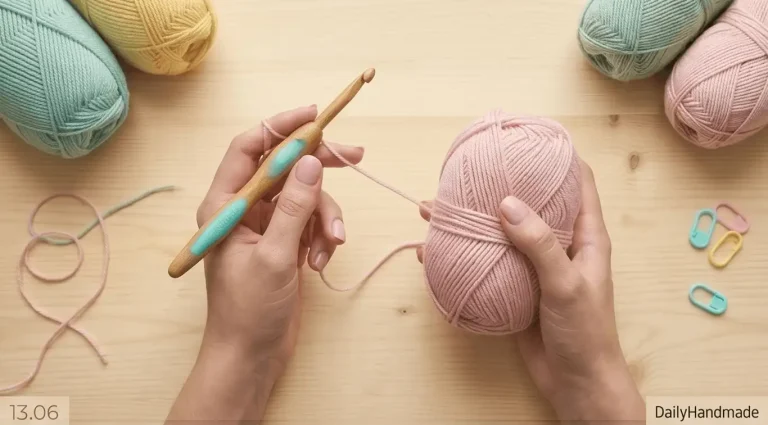
To master your first stitch with professional results, use a 5.0mm ergonomic crochet hook and a smooth, light-colored acrylic worsted weight yarn. Dark or textured yarns hide the “V” of the stitch, making it nearly impossible for beginners to see where to insert the hook.
- Foundation First: You must be comfortable with the chain stitch before attempting a single crochet. The chain creates the tension “track” for your stitches to sit on. (See: Beginner crochet order: stitches before patterns).
- Isolate the Movement: Practice making a small swatch—exactly 10 stitches wide and 10 rows tall. Do not attempt a full scarf yet; the goal is high-quality repetition in a small area.
- Identify the “V”: Look at the top of your single crochet. It looks like a small “V.” Ensure your hook goes under both loops of that “V” every single time to prevent your fabric from leaning or twisting.
- Count Every Row: Before turning your work, count your stitches. If you have 9 or 11 instead of 10, stop and find the mistake immediately. This “Audit Mode” is what separates successful beginners from those who quit.
What To Expect Next
Initially, your single crochet square may look stiff, uneven, or have slightly wobbly edges. This is a sign of your tension stabilizing. Within 3 to 5 small practice swatches, you will notice the hook moving more rhythmically and your stitches appearing uniform. You are ready to move to “Double Crochet” or “Granny Squares” only when your single crochet stitch count remains identical for five consecutive rows.
Return Path
The single crochet is the gateway to the entire crochet system. To see how this stitch fits into the complete beginner roadmap and what your next milestone should be, continue here: Beginner crochet learning order
If you are still struggling with the physical feel of the stitch, these troubleshooting guides will help:
Best crochet hooks for beginners