
Top 5 Best Crochet Stitches for Square Projects
Quick Recognition
You’ve tried making a square with every stitch you know, but the result is always a bit “off.” Your double crochet rows have gaps at the edges, your triple crochets are too floppy to hold a corner, and your circular patterns never quite square off. If you are struggling to get a crisp, geometric finish, the problem might not be your skill—it’s the Stitch Geometry. In Crochet Stitches Explained, we learn that every stitch has a unique height-to-width ratio. Choosing the best crochet stitches for square projects is the shortcut to a professional, “blocky” look.
Direct Answer
The best crochet stitches for square projects are those with high structural stability and a predictable “grid-like” footprint. The Moss Stitch (Linen Stitch) is the gold standard for flat squares due to its interlocking nature. Other top contenders include the Single Crochet (for density), the Granny Stitch (for traditional corners), the Half Double Crochet (for balanced height), and the Waffle Stitch (for 3D structural integrity). These stitches minimize the “lean” that often ruins square geometry.
Why These Stitches Work (The Structural Logic)
As we deep-dive in Pillar #03, a “perfect square” requires a balance between the horizontal width of the stitch and the vertical height of the row. Stitches that are too tall (like Treble Crochet) act like loose hinges, allowing the fabric to skew into a parallelogram. The stitches listed below are “stable anchors” that help you avoid the common pitfalls of Why My Crochet Is Not Square.
1. The Moss Stitch (Linen Stitch)
This is a sequence of [sc, ch 1]. Because the single crochet of the current row is worked into the chain space of the row below, the stitches interlock. This removes the “stacking” lean entirely, making it the most stable stitch for a perfect square.
2. The Traditional Single Crochet (sc)
The sc is the densest stitch in crochet. Its squat shape means there is very little vertical “play,” which keeps your corners at a sharp 90-degree angle. However, remember the ratio: you usually need about 12 rows for every 10 stitches to make it a true square.
3. The Granny Stitch (3-dc clusters)
The classic Granny Square is iconic for a reason. By grouping three double crochets together, you create “blocks” that are easier to count and align. The 2-chain or 3-chain corners act as a fixed hinge that forces the work into a square shape.
Shutterstock
Khám phá
4. Half Double Crochet (hdc)
The hdc is the “Goldilocks” of stitches—taller than a sc but sturdier than a dc. It provides enough drape to be soft but enough structure to prevent the “staircase” edges that cause crooked work.
5. The Waffle Stitch
If you want a square that feels like a solid tile, the Waffle Stitch uses front-post double crochets to create a literal grid on the surface. This “ribbing” acts like a structural frame, preventing the fabric from stretching out of square.
How to Fix Your Geometry (The Selection Protocol)
To ensure your chosen stitch results in a perfect square, follow these Pillar #03 rules:
- Swatch the “Ratio”: Before starting a large project, crochet a 4×4 inch swatch. Count how many rows it took to reach 4 inches compared to how many stitches. This is your “Geometry Key.”
- The “Stacked” First Stitch: When using taller stitches like Double Crochet, use a “Stacked Single Crochet” instead of a turning chain. This creates a solid vertical pillar that supports the corner.
- Check for “Bias Lean”: Some stitches (especially in the round) naturally lean to the right. To fix this, turn your work after every row—even when working in a square “round.”
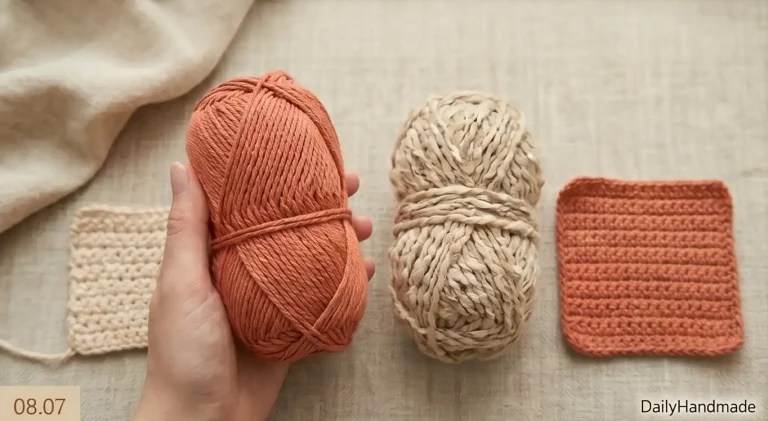
- Use High-Memory Yarn: Pair these stitches with a Worsted Weight (#4) Wool or Acrylic. These fibers hold the “square” shape better than slippery bamboo or silk.
What To Expect Next
When you switch to one of these five stitches, you will notice your “Edge Blindness” disappears. The grid-like nature of the Moss or Granny stitch makes it obvious where the row ends. You will know you’ve mastered best crochet stitches for square projects when you can lay your work down and it naturally holds a 90-degree angle without you having to tug at the corners.
Return Path
Choosing the right stitch is half the battle. To understand how your physical tension might still be skewing these “perfect” stitches, return to our diagnostic guide: Crochet not square due to tension
If your stitch choice is perfect but the edges are still wobbly, explore these rescue and finishing techniques: