
Best Blocking Method for Crochet Beginners: Wet vs. Steam vs. Spray
Quick Recognition
It is a quiet morning in April 2026, and you’ve just finished a project that looked divine in the pattern photos but looks a little “crunchy” or curled on your lap. You might have already mastered how to join crochet pieces, but the final drape just isn’t there yet. You think, “Do I really need to soak this whole thing, or can I just spritz it with water? What is the best blocking method for crochet beginners?” At Dailyhandmade, we view blocking as the “set” of your work. It isn’t just about making it pretty; it’s about using physics to relax the fibers into their permanent home.
Direct Answer
The best blocking method for crochet beginners is entirely dependent on your Fiber Content. Wet Blocking is the gold standard for natural fibers (wool, cotton) as it provides a deep “memory reset.” Steam Blocking is the fastest and best for acrylics that need to be softened or “killed.” Spray Blocking is the “Goldilocks” choice for delicate lace or projects that only need a light touch-up. In the framework, we prioritize safety over speed—choosing a method that relaxes the yarn without damaging the stitch definition.
The Science of the “Set”: Fiber Relaxation
In the technical world of Pillar: Crochet Care & Maintenance Guide, we analyze the Relaxation Factor ($R_f$). This is the degree to which a fiber returns to its “neutral” state after being manipulated by a crochet hook.
$$R_f = \frac{L_{final} – L_{initial}}{\Delta T + \Delta H}$$
Where $L$ is length, $T$ is temperature, and $H$ is humidity/moisture.
| Method | Best For | Intensity | Setup Effort |
| Wet Blocking | Natural Fibers (Wool, Cotton, Linen) | High | High (Needs soaking/drying). |
| Steam Blocking | Acrylic yarn | Medium-Heat | Low (Uses a steamer/iron). |
| Spray Blocking | Lace, Silk, & Light touch-ups | Low | Low (Uses a spray bottle). |
| Mist Blocking | Very delicate/Vintage threads | Very Low | Minimal. |
3 Strategy Drills for Choosing Your Method
If you are trying to find the best blocking method for crochet beginners in Pillar: Crochet Care & Maintenance Guide, run your project through these three professional drills:
1. The “Fiber ID” Audit
Before you wet a single stitch, check the label.
- The Drill: Put a small drop of water on a yarn scrap. Does it soak in immediately (Natural fibers)? Wet blocking is your winner. Does it bead up and roll off (Synthetic)? You’ll likely need the controlled heat of how to steam block acrylic crochet safely to force the plastic polymers to relax.
2. The “Timeline” Reality Check
How much time do you actually have?
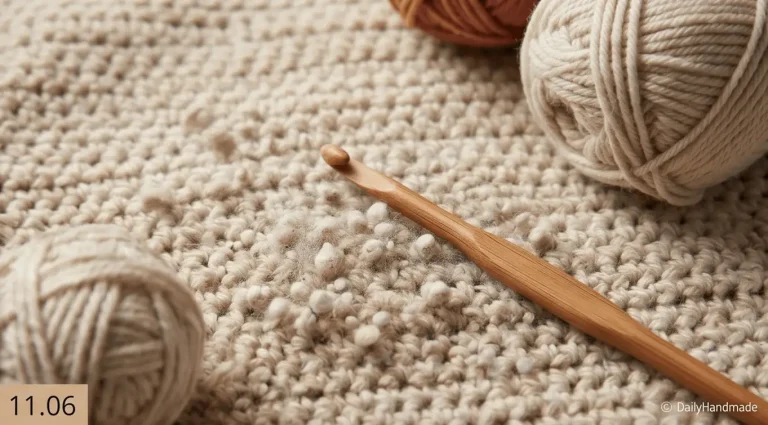
- The Drill: If you need to wear the item tonight, wet blocking is out (it can take 24–48 hours to dry). Spray blocking or steam is your “emergency” route. However, for a permanent fix to crochet still curling after blocking, the time investment of wet blocking is worth every hour.
3. The “Geometric” Precision Goal
Are you matching multiple pieces?
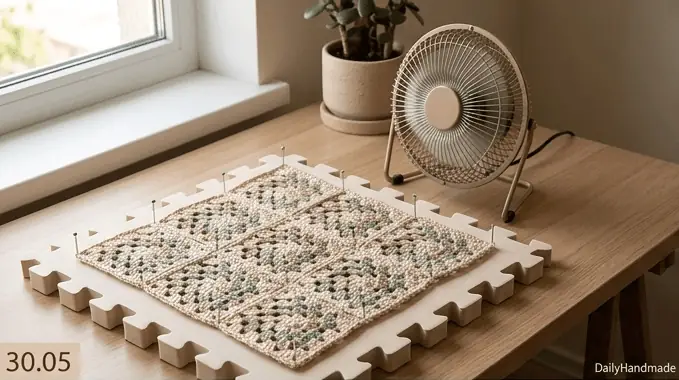
- The Drill: If you are asking should i block crochet motifs before joining, the answer is almost always Wet or Spray. You need the precision of pinning your squares to a specific measurement (e.g., exactly 10cm) on diy blocking mats for crochet to ensure your blanket assembly is perfectly straight.
Dailyhandmade Expert Rescue Signal
The “No-Touch” Warning: In How to Block Crochet Projects (Wet vs. Steam vs. Spray), we always warn beginners: Never touch the iron directly to the yarn! Whether you are steaming or “spritzing,” heat and fiber can be a volatile mix. If you touch an iron to acrylic, you will melt it. If you touch it to wool, you might scorch it. Always keep a 2cm gap or use a pressing cloth.
What To Expect Next
You’ve chosen your method, but what if your yarn is 100% synthetic? Standard water won’t move those plastic fibers. In our next chapter of How to Block Crochet Projects (Wet vs. Steam vs. Spray), we dive into the high-heat technique: How to Steam Block Acrylic Crochet Safely: Avoiding the “Kill.”
Return Path
Selecting the best blocking method for crochet beginners is the first step in the Pillar: Crochet Care & Maintenance Guide. To refine your finishing toolkit, explore these related guides:
- How to steam block acrylic crochet safely
- Blocking granny squares without a blocking board
- Diy blocking mats for crochet
- Should i block crochet motifs before joining
- Master Guide: Crochet Care & Maintenance Guide
I have a relevant follow-up question for you: Are you currently working with a natural fiber (like a soft merino wool) that needs a deep soak, or a sturdy acrylic that just won’t stay flat?