Basic Crochet Diagram Symbols Explained: Your Visual Cheat Sheet
Quick Recognition
It is a breezy afternoon in April 2026, and you’ve just taken your first steps in understanding crochet chart diagrams for beginners. You see the map, but the “street signs” (the symbols) still look like random scratches. You think, “Why is that ‘T’ wearing a sash? And what do those little dots mean?” At Dailyhandmade, we view symbols as the “DNA” of your project. In How to Read Crochet Patterns, we teach you that once you get the basic crochet diagram symbols explained, you can pick up a Japanese or Russian pattern and crochet it perfectly, even if you don’t speak the language.
Direct Answer
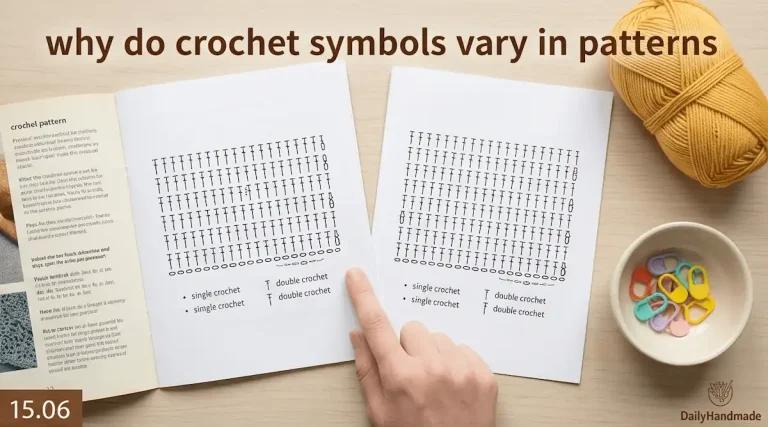
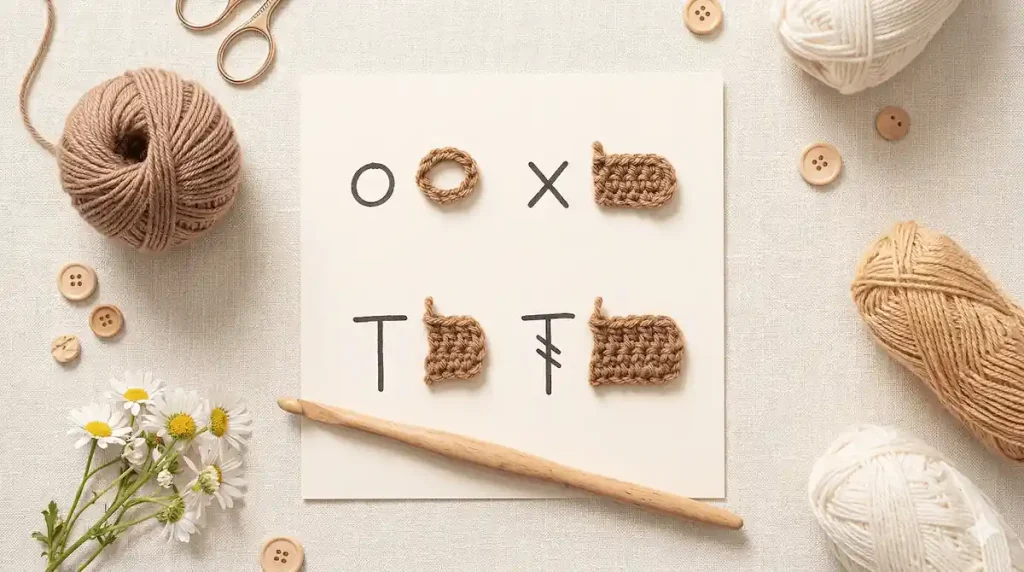
To get basic crochet diagram symbols explained, you must realize that each mark is a literal drawing of the stitch’s anatomy. An oval represents a chain (it looks like a loop). A small cross or plus is a single crochet (short and sturdy). A ‘T’ shape is the universal base for “tall” stitches, where the number of diagonal slashes tells you how many times to “yarn over.” In the framework, we call this Symbolic Anatomy, which allows for 100% accurate stitch identification across all international standards.
The Science of the “Slash”: Height Logic
In the technical world of How to Read Crochet Patterns, the complexity of a symbol is directly proportional to the Stitch Height ($H_s$). The number of slashes ($n$) on the vertical bar determines the stitch type.
$$H_s \propto n + 1$$
| Symbol | Stitch Name | Visual Anatomy |
| Oval / Dot | Chain (ch) | Represents the empty space of a loop. |
| X or + | Single Crochet (sc) | Represents the compact “plus” shape. |
| T (Plain) | Half Double (hdc) | The base bar without a “yarn over” slash. |
| T with 1 Slash | Double Crochet (dc) | The slash represents the one yarn over. |
| T with 2 Slashes | Treble Crochet (tr) | Two slashes = two yarn overs. |
| Filled Dot | Slip Stitch (sl st) | A “flat” symbol for a flat stitch. |
3 Strategy Drills to Master the Alphabet
If you are struggling with basic crochet diagram symbols explained in How to Read Crochet Patterns, run these three identification drills:
1. The “Slash Counter” Drill
Never memorize; just count.
- The Drill: Look at any ‘T’ shaped symbol. Count the slanted lines crossing the vertical bar. Add “one” to that number to know how many times you wrap the yarn before inserting. If there are two slashes, you yarn over twice. This logic prevents the common crochet chart reading mistakes that happen when patterns get complex.
2. The “Oval vs. Dot” Comparison
Is it a chain or a slip stitch?
- The Drill: Look at the small round marks. An open oval is a chain. A solid, filled-in black dot is a slip stitch. Think of the oval as “open air” and the dot as a “solid anchor.” Knowing this distinction is key to how to read crochet diagrams in the round, where slip stitches are used to close the circle.
3. The “Stitch Footprint” Audit
Symbols show you exactly where the “feet” of the stitch go.
- The Drill: Look at where the bottom of a symbol touches the row below. If three ‘T’ symbols all touch the same point, you are working a “cluster” or “increase.” If they are spaced out, you are working a standard row. This spatial layout is much clearer than text when you’re using best ergonomic crochet hooks for high-precision work.
Dailyhandmade Expert Rescue Signal
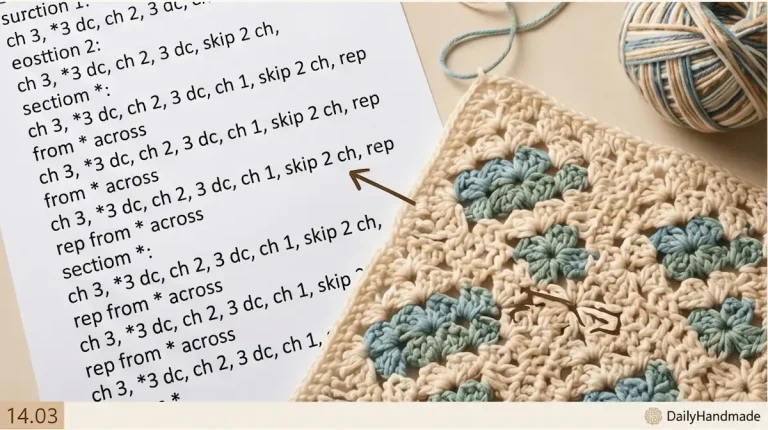
The “US vs UK” Neutralizer: In How to Read Crochet Charts (Diagram Symbols for Beginners), we celebrate diagrams because they eliminate the “Double Crochet” confusion. In written text, a “DC” means something different in the UK than in the US. In a diagram, the ‘T’ with one slash ALWAYS means the same stitch regardless of what the designer calls it. This is the #1 reason to learn basic crochet diagram symbols explained.
What To Expect Next
You’ve mastered the alphabet, but how do you read the “sentences”? Do you start at the top left? Bottom right? In our next chapter of How to Read Crochet Charts (Diagram Symbols for Beginners), we look at the path of the hook for flat projects: How to Read Crochet Diagrams in Rows: Turning Logic.
Return Path
Mastering basic crochet diagram symbols explained is the “decoder ring” for How to Read Crochet Patterns. To continue your visual education, explore these related guides:
- Understanding crochet chart diagrams for beginners
- How to read crochet diagrams in rows
- How to read crochet diagrams in the round
- Crochet chart vs written pattern differences
- Master Guide: How to Read Crochet Patterns
I have a relevant follow-up question for you: Now that you know the “Slash Rule,” can you tell how many yarn-overs a Double Treble would have if you saw it on a chart?