Why Your Crochet Circle Has Flat Sides: Stopping the Polygon Effect
Quick Recognition
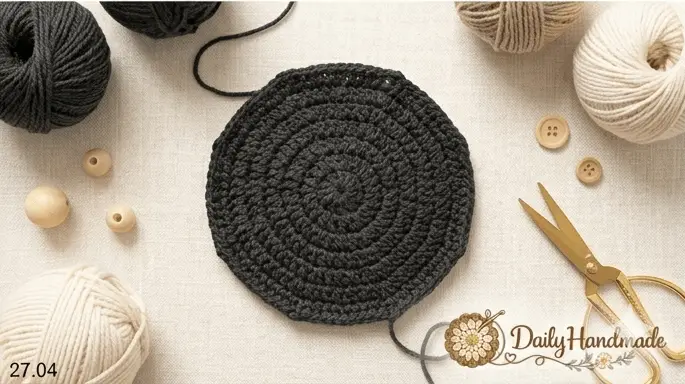
It is a breezy afternoon in 2026, and you’ve just finished Round 10 of a circular rug. You lay it on the floor, expecting a perfect disc, but instead, you see a series of straight edges connected by slight points. It looks more like a stop sign than a circle. You think, “I’m following the pattern perfectly, so why does my crochet circle has flat sides?” At Dailyhandmade, we call this the “Vector Trap.” Crochet is made of individual “blocks” of yarn. If those blocks aren’t positioned strategically, they naturally form a polygon (a shape with straight sides) rather than a continuous curve.
Direct Answer
The reason your crochet circle has flat sides is the mathematical distance between your increase points. In geometry, a straight line between two points on a curve is called a chord. When you place your increases in the same spot every round (stacked increases), the stitches in between act as chords. As the circle grows, the number of “plain” stitches between increases grows larger, making these straight “chords” longer and more visible to the naked eye. In the framework, we stop the Polygon Effect by disrupting these straight lines through staggered increases.
The Flat Side Audit: Chords vs. Arcs
In the technical world of Working in the Round, we calculate the Central Angle ($\theta$) between two increases. The larger the number of stitches ($s$) between increases, the more the “arc” looks like a “flat side.”
$$\text{Side Length} \approx 2r \sin\left(\frac{\theta}{2}\right)$$
| Feature | True Circular Arc | The Polygon “Flat Side” |
| Increase Position | Shifting/Variable. | Fixed/Vertical. |
| Stitch Path | Follows the circumference. | Travels in a straight vector. |
| Visibility | Round and organic. | Geometric and “pointed.” |
| Cause | Even tension and distribution. | Increase stacking. |
3 Strategy Drills to Stop the Polygon Effect
If your crochet circle has flat sides in Working in the Round1, use these three audit drills to reclaim your curve:
1. The “Squint” Diagnosis
Before you frog (rip back), you need to see exactly where the curve died.
- The Drill: Lay your work flat and squint your eyes. This blurs the individual stitches and highlights the silhouette. If you see straight lines, identify which rounds they started on. Usually, flat sides become obvious once you have more than 4 or 5 stitches between increases. This is the moment to start how to stagger increases in crochet circle.
2. The Increase “Buffer” Rule
Flat sides happen because the “plain” stitches are clumped together in one long bridge.
- The Drill: Break the bridge. Instead of doing “6 sc, inc,” try “3 sc, inc, 3 sc.” By placing the increase in the middle of the straight section, you create a new “point” that forces the yarn to turn, effectively turning one long flat side into two smaller, less noticeable segments.
3. The Starting Count Audit
Sometimes the circle has flat sides because the flat crochet circle increase formula was started with too few stitches.
- The Drill: If you start a Single Crochet circle with only 4 or 5 stitches, the angles between increases are too sharp ($90^\circ$ or $72^\circ$). This creates very aggressive flat sides. For a smoother curve, ensure you are starting with at least 6 (for SC) or 12 (for DC) to keep the “chords” short and the transitions smooth.
Dailyhandmade Expert Rescue Signal
The “Rolling” Rescue: If you have already finished a project and your crochet circle has flat sides, don’t panic. Gently roll the edges of the circle between your palms while damp. This “massages” the yarn and helps redistribute the tension of the stacked increases, softening the corners. It’s not a perfect fix, but it’s a great “Dailyhandmade hack” for finished pieces.
What To Expect Next
We’ve looked at the placement of the stitches, but does the height of the stitch matter? Does a Double Crochet circle have flatter sides than a Single Crochet one? In our next chapter of Why Crochet Circle Turns Into a Hexagon, we test the variables: Stitch Height and Crochet Circle Shape: Does Stitch Type Matter?
Return Path
Identifying why your crochet circle has flat sides is a major step in the Working in the Round masterclass. To keep your edges perfectly round, explore these related guides:
- Why does my crochet circle look like a hexagon
- Stacked increases crochet circle
- How to stagger increases in crochet circle
- Flat crochet circle increase formula
- Master Guide: Working in the Round
I have a relevant follow-up question for you: When you look at your flat sides, do they happen in every single section of the circle, or is it only happening on one side where your tension might be a little looser?