
Stacked Increases Crochet Circle: Why Your Rounds Have Points
Quick Recognition
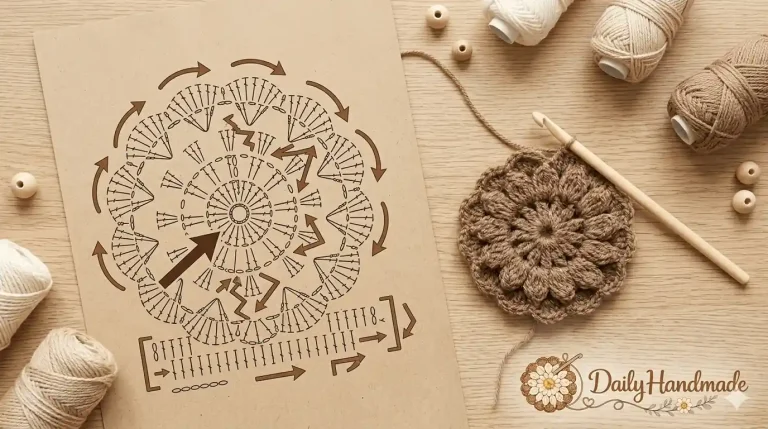
It is a quiet afternoon in 2026. You are halfway through a beautiful circular potholder. You are counting perfectly, and the math is solid. But as you look down, you notice six faint lines radiating from the center, like the spokes of a wheel. At the end of each line, the fabric “points” out. You think, “I’m not making a star, I’m making a circle! Why is the yarn pushing outward like that?” At Dailyhandmade, we identify this as the “Vertical Alignment Trap.” While Why is my crochet circle wavy dealt with quantity, a stacked increases crochet circle is an issue of concentration. You are building invisible walls that turn your curve into a corner.
Direct Answer
A stacked increases crochet circle occurs when you place every “Inc” (increase) directly into the increase stitch of the row below. Because an increase consists of two stitches worked into one, it occupies more physical volume than a single stitch. When these high-volume “double stitches” are stacked vertically, they create a cumulative outward pressure. This pressure forces the radius to expand faster at that specific point than in the “straight” sections between them, resulting in the flat sides and sharp points of a hexagon or octagon. In the Pillar framework, we call this “Point-Loading” the geometry.
The Anatomy of a Point: Displacement Physics
In the technical world of Working in the Round, we can look at the Radial Displacement ($D_r$). In a perfect circle, the displacement from the center should be uniform at every angle ($\theta$).
$$D_r(\theta) = \text{Constant}$$
However, in a stacked increases crochet circle, the displacement at the increase angles ($\theta_{inc}$) is slightly higher due to the extra bulk:
$$D_r(\theta_{inc}) > D_r(\theta_{plain})$$
| Round Feature | Standard Stitches | Stacked Increases |
| Fiber Density | Uniform. | High (Double-layered). |
| Structural Role | Fills the circumference. | Acts as a “Rib” or support pillar. |
| Visual Result | Smooth curve. | A sharp corner or “Point.” |
| Geometry | Infinite points. | Finite vertices ($V=6$ or $V=12$). |
3 Reasons Your Stacks Are Creating Points
If you are diagnosing why a stacked increases crochet circle is ruining your roundness in Working in the Round, look for these three mechanical causes:
1. The “Ending Increase” Pattern
Most basic patterns are written as: Round 4: (2 SC, Inc) repeat 6 times.
- The Result: The “Inc” always lands on the second half of the previous round’s increase. This creates a perfect vertical line of “points.” To break this, you must learn how to stagger increases in crochet circle.
2. Excessive Stitch Definition
If you are using the best yarn for flat crochet circles, such as mercerized cotton, the yarn has zero “give.”
- The Result: The yarn is stiff and “crisp.” This makes the extra bulk of the stacked increases even more obvious. Instead of the fibers blending together, they sit on top of each other like bricks, making the hexagon look unavoidable.
3. Tension “Tightening” at the Increase
Many makers pull their yarn tighter when performing an increase to avoid gaps.
- The Result: This ironically makes the point sharper. The tight “base” of the increase makes the two stitches at the top flare out even more aggressively, pushing the “point” of the hexagon further out into the surrounding space.
Dailyhandmade Expert Rescue Signal
The “Spoke” Check: In Why Crochet Circle Turns Into a Hexagon, we use the “Spoke Test.” Hold your circle up to a bright light. If you see six distinct lines of light or texture radiating from the magic ring to the edge, you are definitely stacking. This is the “Diagnostic Moment” that tells you it’s time to switch to the roundness protocol before the next round.
What To Expect Next
We’ve identified the “stack” as the enemy of the curve. But how do we break the pattern without losing our place in the count? How do we move the increases around so they don’t line up? In our next chapter of Why Crochet Circle Turns Into a Hexagon, we reveal the professional’s favorite secret: How to Stagger Increases in Crochet Circle: The Key to Roundness.
Return Path
Understanding the mechanics of a stacked increases crochet circle is the first step in fixing a polygon problem in Working in the Round. To master your curves, explore these related guides:
- Why your crochet circle look like a hexagon
- How to stagger increases in crochet circle
- Why your crochet circle has flat sides
- Flat crochet circle increase formula
- Master Guide: Working in the Round
I have a relevant follow-up question for you: When you look at your circle, can you clearly see those “spoke” lines radiating from the center, or do the corners just feel like a general “squaring off” of the whole shape?