Flat Crochet Circle Increase Formula: The Universal Round Rule
Quick Recognition
It is a bright morning in 2026, and you’ve decided to tackle a giant circular rug. You remember the frustration of past projects where the edges started ruffling at the edges or curling like a taco. You think, “Is there a secret math equation that the pros use to keep it perfectly flat?” At Dailyhandmade, we call this the “Golden Rule of Rounds.” While crochet is an art, a flat circle is pure science. If you deviate from the flat crochet circle increase formula, gravity and geometry will rebel against you. Mastering this rule is the single most important skill for anyone working in the round — Pillar Master Guide.
Direct Answer
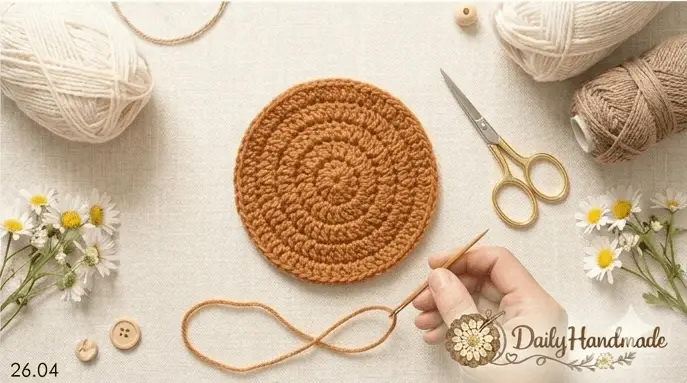
The flat crochet circle increase formula is based on adding the same number of stitches in each round as you started with in Round 1. If your starting ring ($R_1$) has $n$ stitches, every subsequent round ($R_x$) must contain $x \cdot n$ stitches. This ensures the circumference of the circle grows in a linear relationship with the radius, following the geometric constant of $\pi$. In the framework, we call this Linear Expansion. By increasing by the “Magic Number” every round, you provide just enough fabric to keep the project flat without causing a wavy crochet circle.
The Mathematical Blueprint: Round by Round
In the technical world of Pillar: Working in the Round, we calculate the total stitch count ($S$) for any given round ($n$) using this LaTeX formula:
$$S = n \times \text{Base Count}$$
| Round Number | Increase Pattern | Total Stitches (Base 12) | Result |
| Round 1 | Start with Base Number ($X$). | 12 | Flat center. |
| Round 2 | Increase in every stitch. | 24 | Doubling the radius. |
| Round 3 | Increase in every 2nd stitch (1 st, 1 inc). | 36 | Consistent growth. |
| Round 4 | Increase in every 3rd stitch (2 st, 1 inc). | 48 | No ripples. |
| Round $n$ | Increase in every $(n-1)$ stitch. | $n \cdot 12$ | Perfectly flat plane. |
3 Golden Rules for the Flat Circle Formula
If you are applying the flat crochet circle increase formula in Pillar: Working in the Round, these three strategy drills will ensure success:
1. Choose the Correct “Base Number”
The height of your stitch determines your starting count. If you start with too few, the circle will “bowl”; if you start with too many, it will wave.
- SC (Single Crochet): 6–8 stitches.
- HDC (Half Double Crochet): 8–10 stitches.
- DC (Double Crochet): 12 stitches.
- TR (Treble Crochet): 15–18 stitches.
2. The “Staggered Increase” Hack
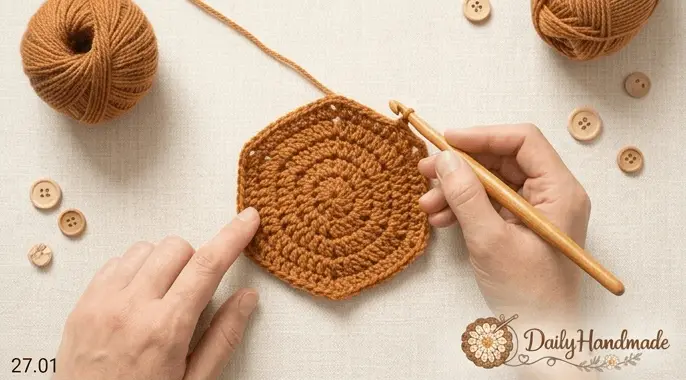
If you always put your increases directly on top of the increases from the previous round, your circle will start to look like a hexagon or a polygon rather than a smooth curve.
- The Drill: Shift the starting point of your increases every other round. This spreads the “stress points” of the extra stitches evenly, preventing corners and keeping the flat crochet circle increase formula looking organic.
3. The “Radius Reset” Audit
As your circle gets larger (Round 15+), your tension might naturally change.
- The Drill: Use a tape measure to check the distance from the center to the edge at four different points. If the measurements differ, your tension is overriding the math. To fix this, consult How to fix wavy crochet circle.
Dailyhandmade Expert Rescue Signal
The “One-Stitch” Warning: In Why My Crochet Circle Is, we say: “A single stitch is a ripple in waiting.” If you find yourself at the end of a round with one extra stitch, do not just “hide” it. That one stitch breaks the flat crochet circle increase formula and will be magnified in the next round. If you miscount, frog it and fix it now!
What To Expect Next
You have the formula, but sometimes circles start flat and then suddenly go wrong after Round 5 or 6. Why does the math seem to fail as the project gets bigger? In our next chapter of Why My Crochet Circle Is, we look at the outer-rim disaster: Crochet Circle Ruffling at the Edges: Solving Round 5+ Ripples.
Return Path
Mastering the flat crochet circle increase formula is the “math heart” of Working in the Round. To keep your geometry perfect, explore these related guides:
- Why is my crochet circle wavy?
- Crochet circle ruffling at the edges
- How to fix wavy crochet circle
- Master Guide: Working in the Round
I have a relevant follow-up question for you: Which stitch do you find the most difficult to keep flat—the tight Single Crochet (SC) or the tall, floppy Double Crochet (DC)?