Does Blocking Stretch Crochet? Friend vs. Foe for Your Stitches
Quick Recognition
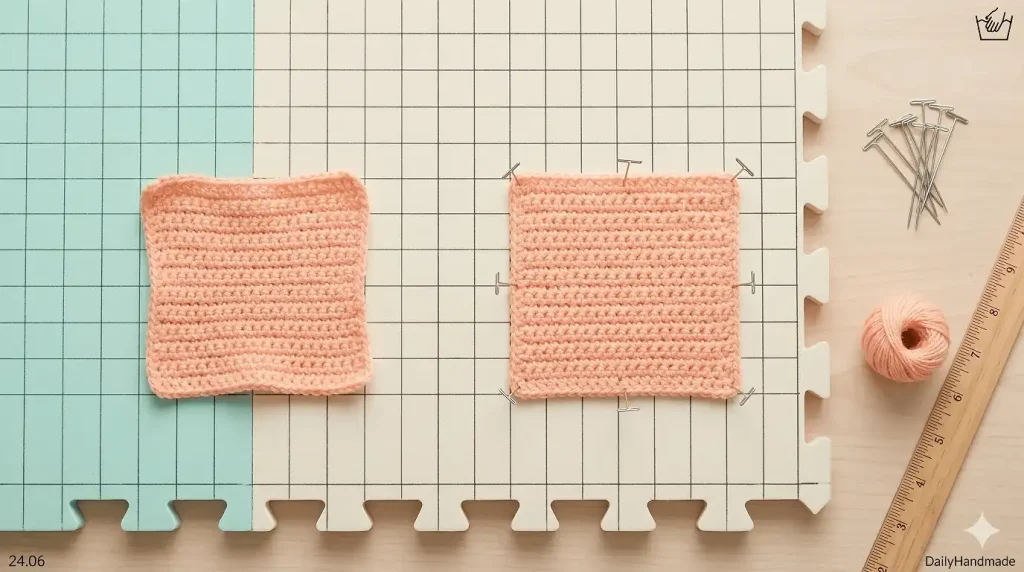
It’s a quiet afternoon in 2026, and you’ve just finished washing your latest project. You lay it out on your foam mats, T-pins in hand. You hesitate. You remember that one time your shawl grew six inches after blocking and never recovered. You think, “Wait, am I just forcing this to be larger? Am I actually damaging the yarn?” At Dailyhandmade, we call this “The Blocking Anxiety.” Many beginners fear that the act of pinning is synonymous with stretching. Understanding does blocking stretch crochet is the difference between a professional, crisp finish and a distorted “Frankenstein” project that no longer fits.
Direct Answer
So, does blocking stretch crochet? The technical answer is: Blocking sets the stitches; it only stretches them if you exceed the yarn’s elastic limit. Blocking uses moisture to “relax” the fibers so they can be guided into the correct shape. If you pin your work to its intended measurements, you are simply restoring its Structural Integrity. However, if you pull the fabric aggressively beyond its natural “ease” while wet, you cause permanent Longitudinal Sag, effectively turning your “Friend” into a “Foe.”
The Blocking Audit: Setting vs. Over-Stretching
In the technical world of Why My Crochet Stretched After Washing, we look at the Stress ($\sigma$) applied to the fibers. Use this table to diagnose your pinning technique:
| Feature | Healthy Blocking (Friend) | Harmful Stretching (Foe) |
| Tension | Fabric feels firm but has “give.” | Pins are pulling the yarn into thin, taut lines. |
| Stitch Look | Lace opens up to show the pattern. | Stitches look distorted or “pointy” at the pins. |
| Goal | Matching the Pattern Gauge. | Forcing a small item to be much larger. |
| Recovery | Fabric maintains shape after unpinning. | Fabric feels “thin” and lacks bounce. |
3 Strategy Drills to Avoid “The Foe”
If you are worried about does blocking stretch crochet in Pillar #10, use these three professional hacks to keep your pins in check:
1. The “Natural Ease” Test
Before you insert a single pin, lay your damp project on the mat and gently pat it into shape with your hands.
- The Rule: If you have to “fight” the fabric to reach a certain measurement, you are stretching, not blocking. Your pins should only hold the fabric where it wants to go after a gentle nudge.
2. The “Pointy Edge” Prevention
When you block, are you seeing “scallops” or points where each pin is placed?
- The Rescue: Use Blocking Wires instead of individual pins for straight edges. Wires distribute the Gravitational Force evenly across the entire edge, ensuring you don’t accidentally stretch specific stitches while others remain tight.
3. The Fiber Elasticity Check
As we discussed in Acrylic vs. Natural, some fibers have better “memory.”
- The Science: Natural wool has a high Elastic Modulus ($E$), meaning it can handle blocking tension and spring back. Cotton and some acrylics have a low $E$; if you pull them too hard while blocking, the Strain ($\epsilon$) becomes permanent.$$\epsilon = \frac{\Delta L}{L_0}$$If your change in length ($\Delta L$) is too high, the fiber will never return to $L_0$.
Dailyhandmade Expert Rescue Signal
The “Pinch” Reassurance: If you’re unsure if you’ve gone too far, unpin one small section. If the fabric immediately “snaps” back into a messy pile, you haven’t blocked it enough. If it stays perfectly in place without any tension, you’ve likely over-stretched it. You want a middle ground where the fabric stays put but still feels “plump.”
What To Expect Next
You now know how to block without fear. But what if the damage is already done? What if you’ve already pulled your project off the mat and realized it’s twice as big as it should be? In our final chapter of Why My Crochet Stretched After Washing, we reveal the emergency room protocol: How to Reshape Stretched Crochet After Washing: The Rescue Protocol.
Return Path
Answering does blocking stretch crochet is a vital part of the Why My Crochet Stretched After Washing series. To keep your projects looking their best, explore these related guides:
- How to reshape stretched crochet after washing
- How to prevent crochet stretching in the wash
- Why crochet stretches after washing: The science of sag
- Master Guide: Crochet Care & Maintenance
I have a relevant follow-up question for you: When you block your projects, do you usually use T-pins on a foam mat, or have you tried using blocking wires to get those perfectly straight edges?