Small Crochet Projects to Practice Tension Without the Stress
Quick Recognition
You’ve got the stitches down, but your work looks… confused. One row is tight and stiff as a board, while the next is loose and full of gaps. You try to fix it while working on a 5-foot scarf, but the more you worry, the tighter you pull. At Dailyhandmade, we call this “Tension Anxiety.” Most beginners quit because they feel they lack the “natural talent” for smooth stitches. The truth? It’s just muscle memory. Finding small crochet projects to practice tension is like going to the gym for your fingers—you need short, repetitive “reps” without the pressure of finishing a masterpiece.
Direct Answer
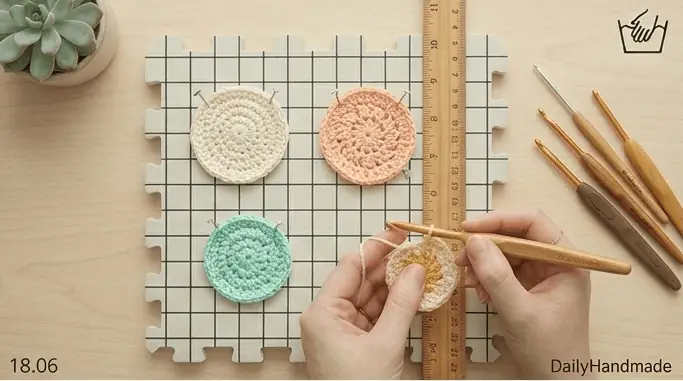
Small crochet projects to practice tension are low-stakes, 15-to-30-minute patterns that allow you to focus entirely on the “feed” of the yarn rather than the complexity of the design. In the framework, we use items like reusable cotton rounds, simple cord keychains, and 2-inch “practice swatches” as diagnostic tools. Because these items are small, if your tension is off, you can frog (rip out) the whole thing and restart in minutes. This rapid-fire repetition is the fastest way to achieve the “Goldilocks” tension—not too tight, not too loose.
The Tension Drill Matrix
Don’t just crochet randomly. Use these specific projects to target your tension weaknesses:
| The Project | Tension Goal | Why it Works |
| Cotton Face Pad | Consistency in Rounds | Forces you to keep your “pull” the same from the center out. |
| Simple Cord Keychain | Tightness Control | Teaches you to maintain a firm (but not painful) grip for durability. |
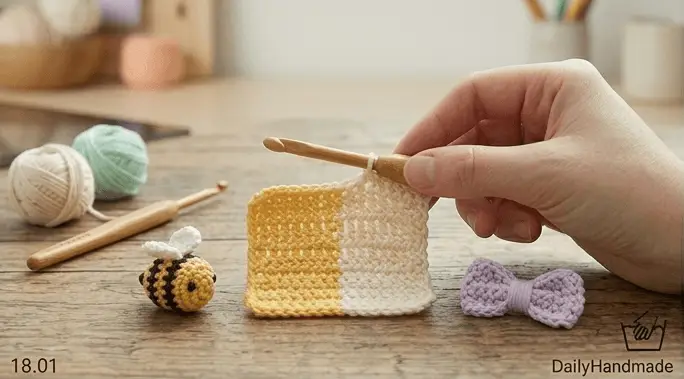
| Ombre Coaster | Yarn-Switching Flow | Helps you keep tension even when changing colors or yarn balls. |
| Mini Bows | Small Space Precision | Drills you on keeping loops consistent in tight, narrow rows. |
3 “Pro-Drills” for Perfect Tension
To turn your small crochet projects to practice tension into a real skill-up, follow these Dailyhandmade strategy drills:
1. The “Hook-Slide” Audit
After every five stitches, stop. Slide your hook back and forth through the current loop.
- If it doesn’t move easily, you’re in a “Death Grip.”
- If it’s flopping around, your tension is too loose.
- The Goal: The hook should feel like it’s gliding on silk—snug but effortless.
2. The “Finger-Feed” Reset
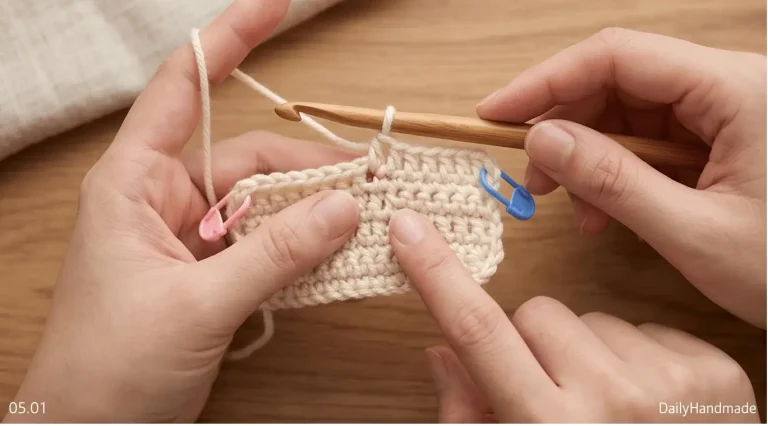
Beginners often wrap the yarn around their pinky, ring, and index fingers like a spiderweb. This creates too much friction. Try a simpler wrap. Practice with a small 2×2 inch square until you find a “feed” that allows the yarn to slide smoothly without you having to “yank” it.
3. The Row-Match Challenge
Crochet a 10-stitch row of single crochet. Measure it with a ruler. Now, crochet another row on top. Is the second row wider or narrower?
- Narrower: Your stress is increasing (you’re tightening up).
- Wider: You’re getting tired (you’re loosening up).
- Small projects allow you to see this “drift” instantly.
The Dailyhandmade Expert Secret
Expert Signal: Tension isn’t just in your fingers—it’s in your shoulders. If you find your small crochet projects to practice tension are still coming out wonky, check your posture. Sit back, drop your shoulders, and breathe. If your body is tense, your yarn will be too.
What To Expect Next
You’ve practiced your drills and your tension is smoothing out. But wait—why does the finished piece still look a little “messy” compared to the photos? Is it the yarn, the hook, or something else? In our final chapter of Quick Crochet Projects for Beginners, we tackle the ultimate beginner question: Why does my crochet look messy?
Return Path
Mastering small crochet projects to practice tension is the foundational “bootcamp” of Quick Crochet Projects for Beginners. To keep your journey on track, explore these next steps:
- Why does my crochet look messy for beginners
- Crochet projects for beginners under 1 hour
- Quick single crochet projects for beginners
- Master Guide: Easy Crochet Projects for Beginners
I have a relevant follow-up question for you: When you’re crocheting, do you feel like you’re fighting the yarn to get the hook through the loops, or do the stitches feel a bit too “airy”? (This tells us exactly which drill you should start with!)