
How the Crochet Turning Chain Causes Uneven Edges
Quick Recognition
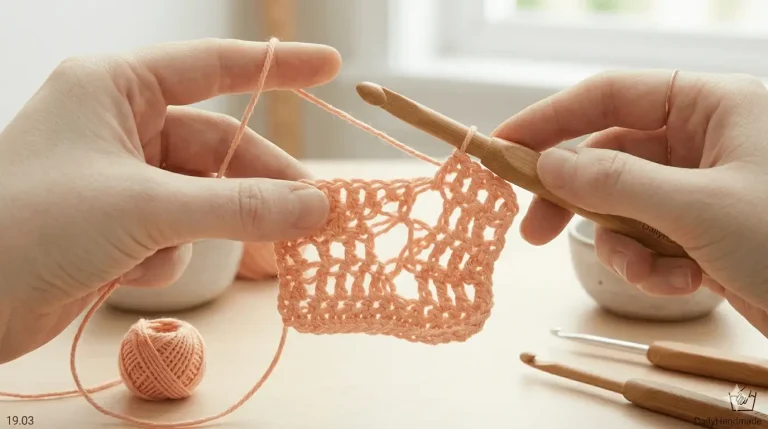
You’ve mastered the basic stitch movement, but the sides of your project look like a zigzag. On one side, there are gaping holes; on the other, there are strange, bulky bumps. You are counting your stitches correctly, yet the edges refuse to look “factory-straight.” If this sounds familiar, you are likely struggling with Turning Chain Turbulence. This happens because crochet turning chain uneven edges are often the result of using the wrong “ladder” height for your stitches or misplacing the very first stitch of the row.
Direct Answer
The crochet turning chain causes uneven edges when the chain’s height does not match the height of the stitch being worked, or when there is inconsistency in whether the chain “counts” as a stitch. If the chain is too loose, it creates a loop/hole on the edge; if it is too tight, it pulls the corner downward, making the edge look scalloped or wavy. Mastery of the turning chain is the “secret sauce” to achieving those elusive, razor-straight project borders.
Why This Happens (The Operational Logic)
In crochet, the turning chain is a vertical bridge. It provides the height needed to start a new row so that your first stitch doesn’t “smush” the fabric.
- The “Gap” Issue: If you count the chain as a stitch but leave too much slack in the yarn, a hole appears between the chain and the next stitch.
- The “Bump” Issue: If you don’t count the chain as a stitch but accidentally crochet into the base of it anyway, you’ve added a stitch, creating a bulge on the side. This structural confusion is the primary reason why crochet turning chain uneven edges persist even for intermediate makers.
How to Fix It (The Turning Protocol)
To eliminate gaps and bumps and stabilize your project’s vertical profile, implement these expert-level adjustments:
- The “Chain-Minus-One” Rule (Expert Signal): If your Double Crochet (dc) edges look loopy with a 3-chain turn, try chaining only 2. This creates a tighter, firmer “post” that mimics the height of a dc without the extra slack that causes holes.
- The Single Crochet “Base-Hit”: In Single Crochet (sc), the turning chain (ch 1) almost never counts as a stitch. You must work your first sc into the very first hole at the base of that chain. This anchors the edge and prevents a “leaning” start. (See: How to Identify the First and Last Stitch in a Crochet Row for stitch identification).
- Tension the Last Loop: Before you chain and turn, ensure the loop on your hook is snug. A loose loop at the moment of turning is the #1 cause of crochet turning chain uneven edges.
- The “Stacked” Single Crochet (Advanced Tip): For a perfectly straight edge in Double Crochet, skip the turning chain entirely and learn the “Stacked Single Crochet” or “Chainless Starting Double Crochet.” These techniques create a solid vertical pillar that looks identical to a real stitch.
- Use a Marker for the “Turn”: If your chain does count as a stitch, place a marker in the top chain immediately after making it. When you return on the next row, you’ll know exactly where to insert your hook for the final stitch. (See: Using Stitch Markers for Straight Edges: The Beginner’s Cheat Code for how to use markers effectively).
What To Expect Next
When you adjust your turning chain height, your edges will transition from “wavy” to “straight” almost instantly. You might notice the corners feel a bit more rigid—this is a good thing! It means the fabric has the structural support it needs. You will know you’ve mastered the turning chain when your project sides look identical to the “V” shapes on the top of your work.
Return Path
Fixing the crochet turning chain uneven edges is a major milestone in Stage 2 learning. To see how this fits into the broader diagnosis of slanted or crooked work, return to our main guide: Why are my crochet edges slanted?
If your edges are straight but your stitch count still feels “off,” explore these specific fixes:
Why my crochet edges are uneven