
Why Does Crochet Feel So Awkward at First? (The Coordination Gap)
Quick Recognition
When you first attempt to manage a crochet hook and yarn, the experience often feels far from the “relaxing hobby” you saw on social media. Instead, your fingers feel stiff, the yarn won’t stop slipping, and the hook feels like a foreign object in your hand. This “physical friction” leads many beginners to believe they lack the necessary hand-eye coordination. In reality, you are simply experiencing the Coordination Gap—a natural phase where your brain understands the instructions, but your motor cortex has not yet built the neural pathways to execute them.
Direct Answer
Crochet feels awkward at first because it requires asymmetrical bilateral coordination—your dominant hand performs a complex “hooking” motion while your non-dominant hand maintains constant, subtle tension. Until these two distinct muscle memories sync into a single rhythmic flow, every movement will feel slow, clunky, and physically taxing. You aren’t failing; you are simply in the “neural-mapping” stage of learning.
Why This Happens (Operational Logic)
Most daily tasks don’t prepare your hands for the specific grip required in crochet. Your brain is currently suffering from Cognitive Overload because it is trying to monitor four variables simultaneously: the hook angle, the yarn flow, the stitch location, and the tension pressure. This overload manifests as a “death grip” on the hook or the yarn, which actually makes the movements harder and leads to the very tightness or slipping you are trying to avoid.
How to Fix It (The Stage 1 Reset)
To shorten the “awkward phase” and start feeling comfortable, implement these expert-level adjustments:
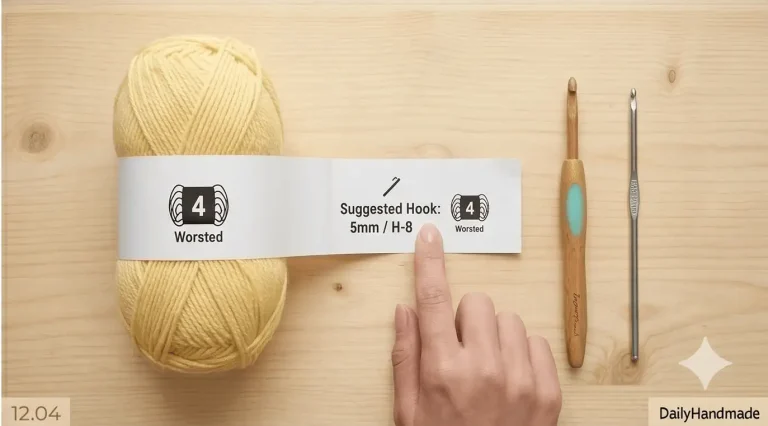
- Transition to an Ergonomic Grip: If you are using a basic metal hook, switch to one with a soft, larger handle. This increases the surface area for your hand to grip, allowing you to relax your muscles while maintaining control. See: The Best Crochet Hook Size for Worsted Weight Yarn.
- The “0.5mm Upsize” Rule: Most beginners naturally pull too tight due to hand tension. Force your loops to stay open by using a 5.5mm hook instead of a 5.0mm. This provides the “visual breathing room” you need to see your stitches. See: What hook size should beginners start with.
- Optimize Your Fiber Surface: Avoid “splitty” cotton or dark wools. Use a smooth, light-colored acrylic yarn that glides over the hook. This reduces the mechanical friction, letting you focus on your hand movements. See: What yarn should beginners use to learn crochet.
- Practice “Chain Sprints”: Don’t try to make a project yet. Crochet 2 yards of chain stitch, then pull it all apart (frog it) and repeat. This builds pure muscle memory for yarn flow without the distraction of stitch placement. See: What to learn first: chain or single crochet.
What To Expect Next
At this stage, your work will look inconsistent—some stitches will be loose, others will be strangling the hook. This is a vital part of the calibration process. You will know you are exiting the “Awkward Phase” when you no longer have to look at your tensioning hand and your grip on the hook feels light, like holding a pencil or a dinner knife, rather than a heavy tool.
Return Path
Feeling awkward is a sign that your brain is actively learning. To see how this stage fits into the complete 3-stage journey of a crocheter, return to the roadmap here: Crochet learning stages explained
If your “awkwardness” is specifically causing physical discomfort or messy results, use these diagnostics: