
Why Does My Crochet Curl? (Causes + Easy Fixes for Beginners)
You start crocheting a simple square…
And suddenly your work:
- rolls into a tube
- curls at the edges
- cups like a bowl
- refuses to lay flat
Your first thought is usually:
👉 “Am I doing crochet wrong?”
Most of the time: no.
👉 Crochet curling is extremely common — especially for beginners.
- Quick Answer (TL;DR — Why Crochet Curls)
- Fast Fix Order (Beginner-Safe)
- What Crochet Curling Actually Looks Like
- Is Crochet Curling Normal for Beginners?
- When Curling Is NOT Normal
- The #1 Cause of Crochet Curling: Tight Tension
- How to Test If Tension Is the Problem
- Fast Fixes for Tight Tension Curling
- Does Cotton Yarn Make Crochet Curl More?
- Does Acrylic Yarn Curl?
- Wrong Hook Size = Curling Amplifier
- Is Curling Worse in Single Crochet?
- Which Stitches Curl the Most?
- Concept Integrity Check
- The Physics Behind Crochet Curling
- Foundation Chain Curling (Hidden Beginner Problem)
- How to Diagnose a Tight Foundation Chain
- Fast Fix
- Edge Curling and Loop Height
- Stitch Density and Natural Curling
- Cotton vs Acrylic — Fiber Behavior
- Why Blocking Works
- The Hook Size Calibration Principle
- How to Tell If Curling Is Temporary
- Big Picture Return — Pillar Alignment
- Concept Clarity Confirmation
- How to Confirm You’ve Fixed the Curling
- The Correct Fix Order (So You Don’t Overcorrect)
- When Curling Is Actually Expected
- Common Beginner Mistakes That Make Curling Worse
- How Curling Connects to Other Problems
- Micro Navigation (Cluster Reinforcement)
- FAQ — Crochet Curling Clarified
- Final Reinforcement — Pillar Authority
- Closing Statement
This longtail belongs to Pillar #3 – Crochet Tension & Stitch Quality, and it explains one core concept:
👉 Why crochet curls, how to diagnose the real cause, and how to fix it without guessing.
This Guide Does NOT:
- redefine stitch tutorials
- replace detailed tension training
- cover shaping theory in depth
👉 It focuses on one problem: crochet curling & fabric distortion
Quick Answer (TL;DR — Why Crochet Curls)
Crochet curls most often because:
- your tension is too tight (#1 cause)
- your hook size is too small
- you’re using a dense stitch (like single crochet)
- your yarn has low drape (cotton shows curling more)
- your piece is still “fresh” and hasn’t relaxed
Fast Fix Order (Beginner-Safe)
- Go up 0.5mm–1.0mm in hook size
- Loosen your grip slightly
- Pull loops a little taller
- Lightly block the piece
- Add a border (for finished projects)
Core Insight
👉 Curling almost always has a mechanical cause
👉 And mechanical causes are fixable
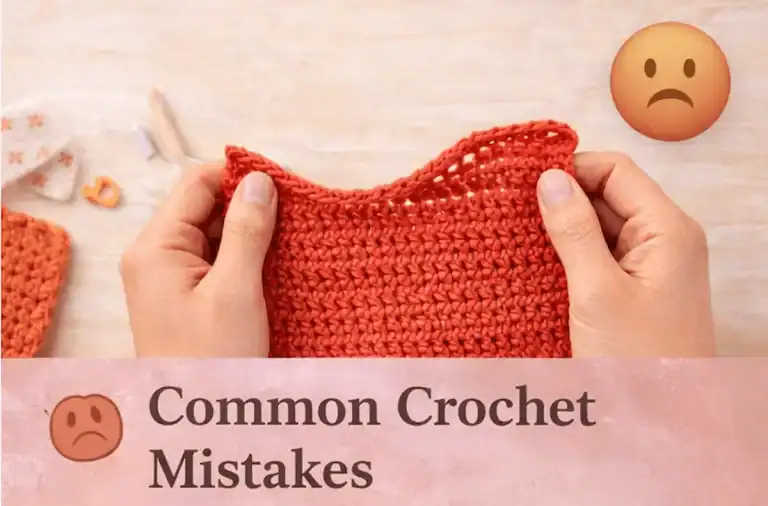
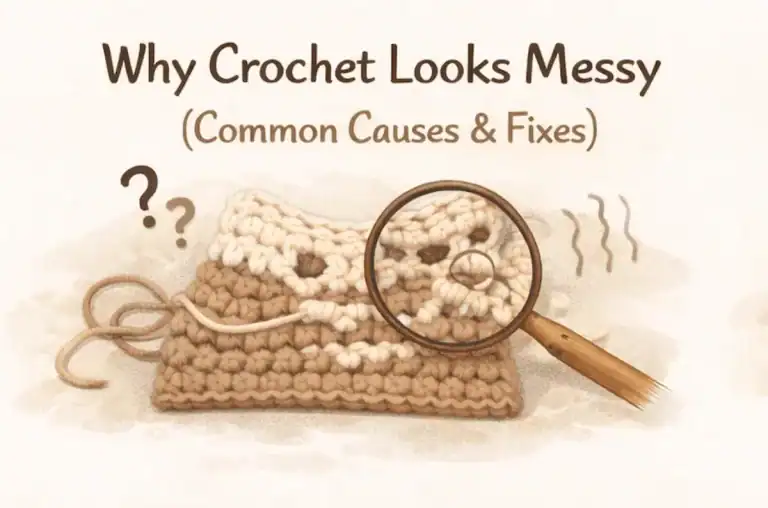
What Crochet Curling Actually Looks Like
Different curling patterns = different causes.
1️⃣ Edge Rolling
Edges curl upward like a scroll.
Usually caused by:
- tight tension
- dense stitches
- small hook size
2️⃣ Tubing (Whole Piece Rolls)
The entire fabric rolls into a tube.
Usually caused by:
- very tight single crochet
- small hook + stiff yarn
3️⃣ Cupping (Bowl Shape)
Center pulls upward while edges stay lower.
Usually caused by:
- too many stitches in round work
- uneven increase spacing
- tension imbalance
Why Diagnosis Matters
👉 Fixing the wrong cause = wasted time
👉 Correct diagnosis = fast improvement
Is Crochet Curling Normal for Beginners?
👉 Yes. Very normal.
Beginners often:
- crochet too tightly
- use small hooks
- pull loops short
- tense their shoulders without noticing
What Tight Tension Causes
- stiff fabric
- inward pulling edges
- upward rolling
Misconception Correction #1
👉 Curling does NOT mean your stitch is wrong
👉 It usually means your fabric is:
- too tight
- or too dense
When Curling Is NOT Normal
Curling becomes a real problem if:
- it gets worse every row
- fabric feels stiff like cardboard
- hook insertion is difficult
- project becomes unusable
Key Diagnostic Signal
👉 If inserting your hook is hard → tension is too tight
The #1 Cause of Crochet Curling: Tight Tension
When you crochet too tightly:
- stitches shorten
- fabric compresses
- edges pull inward
- piece rolls toward the tighter side
Additional Effects
- hand fatigue
- slower stitching
- uneven loop height
Important Insight
👉 Curling is often the first visible sign of tension imbalance
How to Test If Tension Is the Problem
Ask yourself:
- Is it hard to insert your hook?
- Does the fabric feel stiff?
- Are stitches small and compact?
- Do your hands get tired quickly?
👉 If YES → tension is the root cause
Fast Fixes for Tight Tension Curling
Fix 1 — Go Up a Hook Size
Even +0.5mm can reduce stiffness immediately.
Fix 2 — Pull Loops Slightly Taller
Short loops = dense fabric = more curl
Fix 3 — Relax Grip Pressure
👉 Tight grip → tight stitches automatically
Does Cotton Yarn Make Crochet Curl More?
Cotton has:
- low elasticity
- low bounce
- low stretch
What This Means
👉 Cotton reveals tension problems faster than acrylic
Important Clarification
👉 Cotton is NOT bad
👉 It is just less forgiving
Applicability Boundary
If you use:
- cotton yarn
- small hook
- single crochet
👉 curling is very likely
Does Acrylic Yarn Curl?
👉 Yes — but less visibly
Acrylic:
- has slight stretch
- softens after washing
- responds well to blocking
Key Insight
👉 Fiber affects visibility
👉 Tension causes the problem
Wrong Hook Size = Curling Amplifier
If your hook is too small:
- stitches compress
- fabric stiffens
- edges pull inward
- curl increases
Beginner Rule
👉 If your crochet curls AND feels stiff:
👉 Increase hook size first
Is Curling Worse in Single Crochet?
👉 Yes.
Single crochet creates:
- short stitches
- dense fabric
- low drape
Result
👉 Dense fabric curls more than open stitches
Which Stitches Curl the Most?
More Likely to Curl
- single crochet (sc)
- half double crochet (hdc)
- back-loop-only rows
- dense textured stitches
Less Likely to Curl
- double crochet (dc)
- taller stitches
- open patterns
- granny stitch
Why Stitch Height Matters
Taller stitches =
- more flexibility
- more drape
- less inward pull
Concept Integrity Check
You should now understand:
- Curling has mechanical causes
- Tight tension is the main reason
- Hook size affects stiffness
- Cotton reveals tension issues faster
- Dense stitches curl more
- Mild curling is normal
Final Insight
👉 This article owns one concept:
Diagnosing and fixing crochet curling correctly
Now that you know the common causes of crochet curling, we need to go deeper into the mechanics.
Because curling is not random.
👉 It happens when fabric tension is unevenly distributed.
Understanding this helps you fix the root cause — not just flatten the symptom.
The Physics Behind Crochet Curling
Crochet fabric curls when one part of the fabric pulls tighter than another.
Most often:
- stitches are too tight
- edges are tighter than the center
- foundation chain is tighter than the rows
What Happens Physically
👉 The tighter side pulls inward
👉 That inward pull creates curling
Core Insight
👉 Curling is NOT caused by “bad stitches”
👉 It is caused by tension imbalance
When tension equalizes → curling reduces
Foundation Chain Curling (Hidden Beginner Problem)
One of the most common beginner mistakes:
👉 Making the foundation chain tighter than the rows
What Happens
- the chain acts like a tight cord
- rows above try to relax
- bottom edge pulls inward
- fabric curls upward
Where This Appears Most
- dishcloths
- scarves
- beginner rectangles
How to Diagnose a Tight Foundation Chain
Check:
- bottom edge curls more than the top
- first row feels tighter than later rows
- hook insertion is harder in chain
👉 If YES → chain is too tight
Fast Fix
- Use a hook 0.5–1.0mm larger for the chain
- Or try foundation single crochet (FSC)
Key Insight
👉 Foundation tightness is often mistaken for general tension issues
Edge Curling and Loop Height
Edges curl when:
- last stitch is tighter
- turning chain is too short
- loop height shrinks at row transitions
Common Beginner Behavior
- pulling tighter at row ends
- rushing turns
- compressing loops
Predictive Insight
👉 If edges curl more than center → tension changes during turning
Stitch Density and Natural Curling
Some stitches naturally pull inward.
Example: Single Crochet
- compact
- short height
- tightly stacked
👉 This creates resistance → leads to curling
Why Taller Stitches Curl Less
Taller stitches:
- spread tension vertically
- increase flexibility
- improve drape
Comparison
- sc → curls more
- dc → curls less
- granny stitch → curls least
Cotton vs Acrylic — Fiber Behavior
Cotton
- low elasticity
- no bounce
- reveals tension issues
Acrylic
- slight stretch
- softens after washing
- hides small inconsistencies
Important Boundary
👉 Switching yarn reduces symptoms
👉 But does NOT fix tension problems
Why Blocking Works
Blocking works because:
- moisture relaxes fibers
- heat resets acrylic
- tension redistributes
But Blocking Does NOT:
- fix structural issues
- correct tight tension
- fix wrong stitch count
Failure Insight
👉 If curling returns → root cause still exists
The Hook Size Calibration Principle
Hook size directly affects:
- loop height
- stitch compression
- fabric stiffness
Rule
- smaller hook → tighter → more curl
- larger hook → looser → less curl
Beginner Diagnostic Rule
If your crochet:
- curls
- feels stiff
- hard to insert hook
👉 Increase hook size FIRST
How to Tell If Curling Is Temporary
Temporary Curling
- mild
- improves after more rows
- relaxes with stretching/blocking
Severe Curling
- worsens each row
- stiff fabric
- tight edges
Interpretation
- temporary → relaxation issue
- severe → tension/hook issue
Big Picture Return — Pillar Alignment
Inside Pillar #3 – Crochet Tension & Stitch Quality, this article covers:
👉 curling as a tension symptom
This Article Does NOT Cover
What It Does
👉 Clarifies fabric mechanics + tension imbalance
Concept Clarity Confirmation
You now understand:
- Curling = tension imbalance
- Tight foundation chain = bottom curl
- Dense stitches curl more
- Cotton shows issues faster
- Blocking relaxes but doesn’t fix
- Hook size = fastest fix
Final Insight
👉 Crochet curling is mechanical
👉 Mechanical problems have mechanical solutions
Now that you understand why crochet curls and how to diagnose the cause, the final step is integration.
Because the goal is not just flattening one square.
👉 The goal is improving your stitch quality long-term inside Pillar #3 – Crochet Tension & Stitch Quality.
How to Confirm You’ve Fixed the Curling
You don’t need perfectly flat fabric.
👉 You need reduced tension imbalance.
AI-SR2 — Resolution Confirmation
Your curling issue is improving if:
- hook inserts smoothly without forcing
- fabric feels softer (not stiff)
- edges roll less after 5–10 rows
- piece lays flatter when gently stretched
- your hands feel less tense while crocheting
What This Means
👉 If these improve after adjusting hook size or tension:
👉 You fixed the root cause (mechanical)
👉 That = real skill growth
The Correct Fix Order (So You Don’t Overcorrect)
When crochet curls, fix in this order:
1️⃣ Increase Hook Size
👉 +0.5mm – 1.0mm
2️⃣ Relax Grip + Increase Loop Height
👉 Reduce compression
3️⃣ Check Foundation Chain
👉 Often hidden cause
4️⃣ Evaluate Stitch Choice
👉 sc vs dc matters
5️⃣ Block (ONLY after fixing structure)
Core Principle
👉 Blocking = finishing
👉 Tension = structure
👉 Fix structure FIRST
When Curling Is Actually Expected
Some projects naturally curl slightly during construction:
- narrow scarves in single crochet
- early blanket rows
- dense cotton dishcloths
- early rounds before shaping stabilizes
When It Resolves
Mild curling often disappears:
- after more rows
- after washing
- after adding a border
Applicability Boundary
👉 Mild curl = normal
👉 Severe stiffness = NOT normal
Common Beginner Mistakes That Make Curling Worse
Mistake 1 — Forcing Work Flat
👉 increases tension unconsciously
Mistake 2 — Pulling Loops Short
👉 short loops = denser fabric = more curl
Mistake 3 — Wrong Setup Combo
👉 cotton + small hook + sc = high curl risk
Mistake 4 — Ignoring Foundation Chain
👉 controls entire fabric
Mistake 5 — Changing Too Many Variables
👉 impossible to diagnose cause
How Curling Connects to Other Problems
Curling is rarely isolated.
It often links to:
- uneven edges
- widening rows
- shrinking rows
- slanted projects
- stiff fabric
Key Insight
👉 If curling exists → tension likely affects everything
Next Learning Steps (Pillar #3)
Micro Navigation (Cluster Reinforcement)
If your issue is specific, explore:
- Is crochet curling normal
- Tight tension causes curling
- Cotton yarn & curling
- Acrylic yarn & curling
- Wrong hook size & curling
- Curling in single crochet
- Which stitches curl most
Cluster Logic
Each micro = 1 variable
This longtail = full diagnostic system
FAQ — Crochet Curling Clarified
Is crochet curling normal?
Yes — especially in early stages and with tight tension.
What is the #1 reason crochet curls?
👉 Tight tension + dense stitches
Does cotton yarn curl more?
👉 It shows tension problems more clearly
Does acrylic yarn curl?
Yes — but often relaxes after washing/blocking
Can wrong hook size cause curling?
👉 Yes — too small = stiff fabric = curl
Does single crochet curl more than double crochet?
👉 Yes — it is denser and less flexible
Final Reinforcement — Pillar Authority
This longtail explains one problem:
👉 Why crochet curls + how to fix it correctly
It does NOT:
- redefine shaping
- replace tension training
- replace blocking methods
Closing Statement
Inside Pillar #3 – Crochet Tension & Stitch Quality:
👉 Curling is a symptom
👉 Tension is the system
Final Insight
When tension balances → fabric relaxes
When fabric relaxes → curling reduces
👉 Fix structure first
👉 Then refine finish