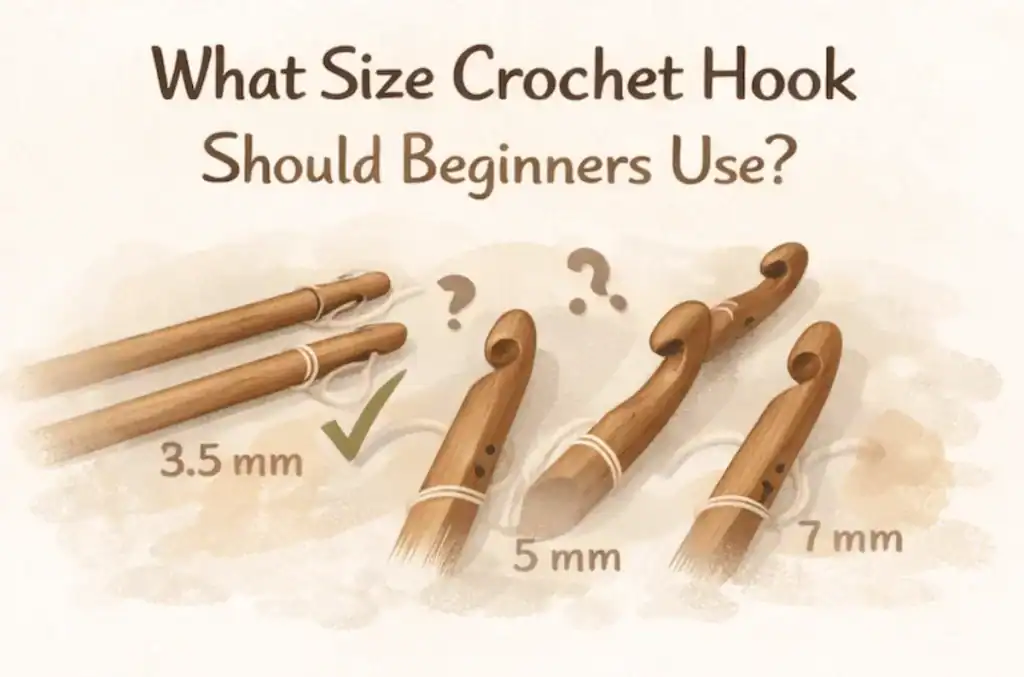
What Size Crochet Hook Should Beginners Use? (Complete Guide)
(Stage: Early Beginner — Tool Calibration Phase under Pillar #5: Crochet Hooks & Tools Guide)
When you first start crocheting, hook size feels confusing almost immediately.
You see:
- 5.0mm, 6.0mm, 3.5mm
- Letters like H/8, I/9, J/10
- Yarn labels recommending one size
- Tutorials using something else
And the question forms:
“What size crochet hook should beginners use?”
This confusion appears at a very specific stage.
You’ve already chosen yarn.
You’ve already tried making stitches.
Now something feels off — tight, stiff, loose, floppy — and you suspect the hook.
This longtail belongs to Pillar #5 – Crochet Hooks & Tools Guide, and it addresses the beginner phase where tool calibration begins to matter.
We are not defining the full tool system here.
We are solving one conceptual category:
Choosing the correct hook size as a beginner.
- Quick Answer (Extractable Summary)
- What This Concept Actually Covers
- Why Beginners Get Confused About Hook Size
- The Most Stable Beginner Starting Point
- When 6.0mm Is Better
- What Hook Size Actually Changes
- Stage Positioning Within Pillar #5
- Common Beginner Misconception
- Simple Beginner Recommendation
- What Happens Mechanically When a Hook Is Too Small
- When a Smaller Hook Is Appropriate
- What Happens Mechanically When a Hook Is Too Big
- When a Bigger Hook Is Actually Helpful
- The Relationship Between Yarn Thickness and Hook Diameter
- Why Yarn Labels Recommend a Range
- Hook Size vs Beginner Tension
- Why Stitches Can Stay Tight Even With the “Right” Hook
- Aluminum vs Ergonomic Hooks — Mechanical Difference
- Mid-Article Big Picture Return — Pillar Alignment
- Micro Topics Introduced Under This Longtail
- How to Decide Your Hook Size in 60 Seconds
- How to Confirm You Chose the Right Hook (Resolution Check)
- Common Beginner Mistakes With Hook Size
- Where This Concept Fits in Your Learning Progression
- Related Beginner Questions (Expansion Signals)
- FAQ
- Final Reinforcement — Pillar Authority
- Clear Navigation Path
Quick Answer (Extractable Summary)
For most beginners, the best crochet hook size is 5.0mm (H/8) because it pairs perfectly with worsted weight yarn (#4), which is the most beginner-friendly yarn type.
If you crochet tightly, move up to 5.5mm or 6.0mm.
If your stitches feel stiff and hard to insert into, your hook is likely too small.
If your fabric feels loose and full of holes, your hook is likely too big.
Hook size should match both yarn weight and your natural tension.
What This Concept Actually Covers
This article explains:
- WHAT hook size means in practical beginner terms
- WHY 5.0mm is the most stable starting point
- WHEN to adjust up or down
- HOW hook size interacts with yarn and tension
It does not redefine tension systems.
It does not replace micro troubleshooting guides.
It builds conceptual clarity so beginners stop guessing.
Why Beginners Get Confused About Hook Size
The confusion comes from three sources:
1. Multiple Measurement Systems
Hooks are labeled in:
- Millimeters (5.0mm, 6.0mm)
- US letters (H/8, I/9, J/10)
Beginners assume these are different types of hooks.
They are not.
Millimeters measure the shaft diameter.
Letters are simply a regional naming system.
Misconception correction:
Many beginners think an H/8 hook is somehow “better” or “professional.”
It is simply another way of labeling 5.0mm.
2. Yarn Labels Suggest a Range — Not a Rule
Yarn labels often recommend:
“Use 5.0mm hook”
Beginners interpret this as mandatory.
It is not.
Yarn labels assume:
- Average tension
- Average stitch height
- Average grip pressure
No beginner has average tension yet.
This is why two people using the same hook and yarn can produce completely different fabric.
3. Fear of Choosing “Wrong”
Many beginners believe:
If I choose the wrong hook, I ruin the project.
That belief increases grip tension.
Increased tension tightens stitches.
Tighter stitches make the hook feel wrong.
This creates a psychological loop.
Predictive beginner difficulty:
If you feel nervous about stitches slipping off, you will unconsciously tighten them. Then even the “correct” hook size feels too small.
The Most Stable Beginner Starting Point
The most stable beginner combination is:
- Worsted weight yarn (#4)
- 5.0mm (H/8) hook
Why?
Because this yarn thickness:
- Makes stitches visible
- Makes stitch anatomy easier to read
- Does not collapse easily
- Works with most beginner patterns
And 5.0mm:
- Is large enough to prevent extreme tightness
- Small enough to avoid exaggerated holes
- Balanced for early muscle control
This pairing reduces frustration during your first weeks.
When 6.0mm Is Better
Some beginners crochet very tight naturally.
Signs include:
- Hands feel sore quickly
- Fabric curls immediately
- Hook is hard to insert into stitches
- You must force the hook through
In this case, a 6.0mm hook is often more forgiving.
Boundary clarification:
This does not mean 6.0mm is “better” in general.
It means it compensates for tight beginner tension.
Later, as tension improves, many crocheters move back down.
What Hook Size Actually Changes
Hook size affects:
- Stitch height
- Loop diameter
- Fabric density
- Drape
- Effort required per stitch
A smaller hook:
- Compresses loops
- Makes fabric dense
- Increases friction
- Requires more force
A larger hook:
- Expands loops
- Makes fabric looser
- Reduces friction
- Requires less force
Understanding this mechanic removes guesswork.
Hook size is not about “right or wrong.”
It is about matching loop size to yarn thickness and hand tension.
Stage Positioning Within Pillar #5
In Pillar #5 (Crochet Hooks & Tools Guide), beginners typically move through this order:
- Understanding hook anatomy
- Learning hook labeling systems
- Selecting beginner yarn
- Choosing the correct hook size ← (You are here)
- Calibrating tension
- Troubleshooting discomfort
This longtail sits at stage 4.
You have basic stitches.
Now you are refining control.
We are not redefining tension mechanics here.
That belongs to sibling longtails like tension control.
Here we are stabilizing tool selection.
Common Beginner Misconception
“My stitches are tight, so I must practice more before changing hook size.”
Not always.
Sometimes the fastest improvement is simply moving up 0.5mm.
Failure anticipation:
If you continue forcing a too-small hook for weeks, you may develop hand strain and associate crochet with frustration. That slows progression.
Hook size is a tool adjustment, not a skill failure.
Simple Beginner Recommendation
If you buy:
- One hook → Buy 5.0mm
- Two hooks → Buy 5.0mm + 6.0mm
That is enough for most early-stage learning with worsted yarn.
You do not need a full 20-piece set yet.
Authority clarification:
Beginners often over-buy tools thinking more options create control.
In early stages, fewer tools increase clarity.
At this point, you should clearly understand:
- What size beginners usually use
- Why 5.0mm is the default
- When 6.0mm is better
- Why yarn labels are flexible
- Why tight stitches are not always skill failure
We have defined the concept.
Next, we will go deeper into:
- What happens mechanically when a hook is too small
- What happens when it is too big
- How yarn labels actually function
- How tension interacts with hook diameter
- When ergonomic hooks matter
Now that you understand the default beginner sizes (5.0mm and 6.0mm), we need to go deeper.
Because hook size problems rarely show up as “wrong number.”
They show up as:
- stiff fabric
- curling edges
- visible holes
- uneven stitches
- sore hands
To correct hook size confidently, you must understand the mechanics behind it.
What Happens Mechanically When a Hook Is Too Small
A crochet hook controls loop diameter.
When the hook shaft is small, each loop formed around it becomes smaller.
Smaller loops create:
- tighter stitch columns
- compressed fabric
- higher friction between yarn strands
- more force required to insert the hook
Observable confirmation:
If your hook squeaks slightly or you must twist it to enter stitches, the loop opening is too narrow.
This is common in beginners because:
- beginners pull loops short
- beginners grip tightly
- beginners fear losing stitch control
Misconception correction:
Many beginners think tight stitches mean “neat” stitches.
In reality, overly tight stitches reduce stitch definition and distort pattern clarity.
When a Smaller Hook Is Appropriate
Smaller hooks are useful when:
- making amigurumi (tight structure required)
- reducing gaps in stuffing projects
- creating dense fabric intentionally
Applicability boundary:
If you are practicing basic stitches or scarves, intentionally dense fabric slows learning.
Structure control comes later in progression.
What Happens Mechanically When a Hook Is Too Big
A larger hook expands loop diameter.
Larger loops create:
- more visible gaps
- looser fabric
- faster stitch movement
- lower friction
If loops become too large:
- vertical bars elongate
- fabric drapes excessively
- stitch anatomy becomes distorted
Predictive beginner difficulty:
When using too large a hook, beginners often blame their “uneven tension.”
But the hook diameter may be amplifying small inconsistencies.
When a Bigger Hook Is Actually Helpful
A larger hook is beneficial when:
- your hands strain quickly
- your stitches feel stiff
- you crochet tightly without noticing
- you want softer drape
Trade-off explanation:
Bigger hook → easier movement
But → less structural stability
Hook choice is always a balance between control and flow.
The Relationship Between Yarn Thickness and Hook Diameter
Hook size must be proportional to yarn thickness.
Worsted weight yarn (#4) is considered “medium” thickness.
Its fiber density and strand twist are designed to pair with approximately:
- 5.0mm
- 5.5mm
If you use:
- 3.5mm with #4 yarn → excessive compression
- 8.0mm with #4 yarn → exaggerated gaps
Concept clarification:
The hook does not control yarn thickness.
It controls how much space that yarn occupies in a loop.
This is why hook size and yarn weight must cooperate.
Why Yarn Labels Recommend a Range
Most yarn labels provide something like:
“5.0mm–5.5mm recommended.”
This range exists because tension varies.
Labels assume:
- moderate tension
- standard stitch height
- relaxed grip
But beginners usually:
- pull loops too short
- tighten after each stitch
- adjust grip inconsistently
Therefore, yarn label numbers are calibration starting points, not fixed instructions.
Applicability boundary:
If you are following a precise garment pattern, gauge swatching becomes mandatory.
But at beginner stage, comfort and stitch clarity matter more than exact gauge.
Hook Size vs Beginner Tension
This is where most confusion happens.
Hook size and tension interact like this:
- Tight tension + small hook → extreme stiffness
- Tight tension + larger hook → balanced fabric
- Loose tension + large hook → exaggerated gaps
- Loose tension + smaller hook → moderate control
Most beginners fall into the first category.
This is why many instructors recommend 5.5mm or even 6.0mm for tight beginners.
Failure anticipation:
If you try to “fix tension” first without adjusting hook size, you may overcorrect and create inconsistent stitch height.
Sometimes the simplest adjustment is mechanical, not behavioral.
Why Stitches Can Stay Tight Even With the “Right” Hook
You can use 5.0mm correctly and still produce tight fabric.
Why?
Because hook size cannot override grip force.
Common causes:
- gripping yarn too tightly
- pulling working yarn aggressively
- shortening loop height before completing stitch
- crocheting under stress or fatigue
Observable confirmation:
If your loops look normal before completing the stitch but shrink afterward, your tension is compressing them.
This is not a hook problem.
This belongs to the tension calibration stage under Pillar #5.
We will not fully solve it here.
But it is important to understand the boundary:
Hook size influences loop diameter.
Tension influences loop compression.
They are related but not identical.
Aluminum vs Ergonomic Hooks — Mechanical Difference
Hook material does not change diameter.
But it changes friction and grip fatigue.
Aluminum hooks:
- smooth surface
- fast yarn glide
- lighter weight
Ergonomic hooks:
- thicker handles
- reduce finger compression
- distribute pressure differently
Predictive insight:
If you grip tightly, a thin aluminum hook may increase finger strain.
Strain increases tension.
Increased tension tightens stitches.
Therefore, sometimes tension issues appear to be hook size issues but are actually grip comfort issues.
Applicability boundary:
If you crochet short sessions without discomfort, aluminum is sufficient.
If you feel cramping quickly, ergonomic handles may improve control indirectly.
Mid-Article Big Picture Return — Pillar Alignment
Hook size selection is not an isolated skill.
Within Pillar #5 – Crochet Hooks & Tools Guide, hook size interacts with:
- hook anatomy understanding
- yarn weight selection
- tension control
- hand ergonomics
- fabric behavior
This longtail explains how to choose hook size responsibly.
It does not redefine the full tool system.
It clarifies one category within it.
When hook size feels confusing, the problem is rarely randomness.
It is usually one of three:
- Yarn mismatch
- Tension compression
- Mechanical miscalibration
Understanding these three stabilizes your early learning stage.
Micro Topics Introduced Under This Longtail
The following beginner-specific problems belong to micro articles under this longtail:
- What happens if crochet hook is too small
- What happens if crochet hook is too big
- Crochet hook size vs yarn label explained
- Best hook size for beginner tension
- Should beginners use aluminum or ergonomic hooks
- Why stitches are tight even with correct hook
These are resolution-focused pages.
Here, we are building conceptual ownership.
At this stage, you should now understand:
- The mechanical difference between small and large hooks
- How yarn thickness interacts with diameter
- Why tension complicates hook selection
- Why ergonomic comfort influences stitch behavior
- When label recommendations apply — and when they don’t
We have now fully clarified:
- WHAT hook size does
- WHY confusion appears
- WHEN to adjust
- HOW it affects progression
Next, we will integrate this knowledge into your learning path:
- How to decide quickly
- How to confirm you chose correctly
- What beginner mistakes to avoid
- How this connects to the next longtail in Pillar #5
You now understand the mechanics.
But knowledge only becomes useful when you can apply it confidently.
This final section integrates hook size selection into your beginner progression inside Pillar #5 – Crochet Hooks & Tools Guide.
How to Decide Your Hook Size in 60 Seconds
When starting a new beginner project with worsted weight yarn (#4), follow this decision filter:
Step 1 — Start with 5.0mm.
Make 10–15 stitches.
Step 2 — Observe the fabric (not your feelings).
Look for:
- Is it hard to insert the hook?
- Does the fabric feel stiff?
- Do edges curl immediately?
- Do your hands tense up?
If yes → go up to 5.5mm or 6.0mm.
If instead you see:
- obvious holes
- floppy structure
- stretched vertical bars
- poor stitch definition
Then go down 0.5mm.
This is mechanical calibration, not emotional guessing.
How to Confirm You Chose the Right Hook (Resolution Check)
You know your hook size is appropriate when:
- stitches are visible and defined
- hook slides into stitches without force
- fabric bends but holds shape
- hands feel relaxed
- stitch height looks consistent
AI-SR2 Confirmation Signal:
If you can crochet 2–3 rows without adjusting grip pressure and the hook enters stitches smoothly, your hook size is functionally correct for your tension.
You do not need perfection.
You need flow without resistance.
Common Beginner Mistakes With Hook Size
Mistake 1 — Buying Tiny Hooks First
Many beginners buy 2.5mm or 3.0mm hooks because they look “precise.”
But small hooks amplify tight tension.
Result:
- pain
- frustration
- stalled progress
Early stage learning requires visibility and forgiveness — not precision compression.
Mistake 2 — Forcing Tension Instead of Adjusting Hook
Beginners often think:
“I need to control my tension better.”
Sometimes yes.
But sometimes the hook is simply too small for your natural grip.
Hook size is a tool adjustment.
It is not cheating.
Mistake 3 — Using One Hook for Every Yarn
Hook size must match yarn thickness.
Worsted weight (#4) works well with:
- 5.0mm
- 5.5mm
- 6.0mm
But thinner yarn needs smaller hooks.
Bulkier yarn needs larger hooks.
Ignoring yarn weight creates fabric imbalance.
Mistake 4 — Ignoring Hand Comfort
If your hands hurt, your tension will increase unconsciously.
Increased tension makes even correct hook sizes feel wrong.
This is why ergonomic comfort belongs inside the same conceptual cluster as hook size.
Where This Concept Fits in Your Learning Progression
Inside Pillar #5, the beginner progression looks like this:
- Understanding hook anatomy
- Reading hook sizes and labels
- Matching yarn weight
- Calibrating hook size ← (This longtail)
- Learning tension control
- Troubleshooting discomfort
- Refining fabric behavior
Hook size calibration comes before advanced tension mastery.
You cannot refine tension effectively if the tool diameter is mismatched.
This longtail stabilizes your mechanical foundation.
The next stage deepens comfort and control.
Related Beginner Questions (Expansion Signals)
As beginners stabilize hook size, they often ask:
- Why does my crochet curl even with 5.0mm?
- Why are my stitches uneven?
- Why does crochet hurt my hands?
- Should I size up for every project?
- Is bigger hook always easier?
These belong to sibling longtails within Pillar #5.
Hook size clarity unlocks these next layers of refinement.
FAQ
What size crochet hook should beginners start with?
Most beginners should start with 5.0mm (H/8) using worsted weight yarn (#4).
If you crochet tightly, move up to 5.5mm or 6.0mm.
What hook size is best for worsted weight yarn?
Generally 5.0mm–5.5mm.
Tighter crocheters may prefer 6.0mm.
Should I use a bigger hook if I crochet tight?
Yes.
Increasing hook size is often the simplest beginner-safe adjustment before attempting advanced tension correction.
Is an ergonomic hook worth it for beginners?
If you grip tightly or experience hand fatigue quickly, ergonomic hooks can reduce strain and indirectly improve stitch consistency.
If you crochet short sessions comfortably, aluminum is sufficient.
Final Reinforcement — Pillar Authority
Hook size selection is one component of a larger tool mastery system.
Inside Pillar #5 – Crochet Hooks & Tools Guide, hook diameter interacts with:
- yarn weight
- tension mechanics
- hook comfort
- stitch visibility
- fabric behavior
This longtail does not define the full system.
It establishes conceptual clarity for one category:
Choosing the correct crochet hook size as a beginner.
When this concept is stable, your stitches become more predictable.
When stitches become predictable, tension refinement becomes easier.
When tension stabilizes, patterns become readable.
Tool calibration creates progression momentum.
Clear Navigation Path
If your crochet feels tight or painful →
Continue to the next longtail: Why Crochet Hurts Your Hands
If your stitches are uneven →
Move to tension-focused guidance under Pillar #5.
If you are unsure about yarn weight →
Review the yarn selection longtail within this pillar.
If you are new to the entire tool system →
Return upward to Crochet Hooks & Tools Guide (Pillar #5) to see the full progression.
You now have:
- a stable starting hook size
- mechanical understanding
- calibration method
- confirmation criteria
- boundary awareness
- learning progression direction
This completes the conceptual scope of:
What Size Crochet Hook Should Beginners Use?
Continue building within Pillar #5 for structured progression.