Crochet Pattern Symbols Explained (Beginner Guide to Charts)
If Crochet Charts Make You Feel Lost, You’re Not Behind
If you’ve ever opened a crochet pattern and seen:
- circles
- X’s
- T shapes
- dots
- arrows
…you may have thought:
“What is this? Is this even crochet?”
Yes.
It is crochet.
You’re looking at a crochet symbol chart (also called a crochet diagram).
And confusion at this stage is completely normal.
This longtail belongs to Pillar #6 – How to Read Crochet Patterns.
At this stage in the learning progression, you already understand basic stitches.
Now you’re learning how patterns communicate them visually.
You are not learning new stitches here.
You are learning a new language for stitches you already know.
- If Crochet Charts Make You Feel Lost, You’re Not Behind
- Quick Answer (40–60 Word Extractable Summary)
- What Are Crochet Symbol Charts?
- Why Crochet Symbol Charts Exist
- Why Charts Sometimes Feel Harder Than Written Patterns
- The Core Concept You Must Understand First
- Beginner Misconception #1
- Why This Concept Appears at This Stage (Pillar Alignment)
- When Charts Are Actually Easier Than Written Patterns
- The Real Source of Beginner Confusion
- Stage Insight: Charts Do Not Replace Written Patterns
- Applicability Boundary
- What You Should Understand Before Continuing
- 1. The Hidden Logic Behind Crochet Symbols
- 2. Why Symbols Look Different in Different Patterns
- 3. Direction Arrows: The Real Source of Confusion
- 4. Repeats in Charts (Why They Look Different Than Written Patterns)
- 5. US vs UK Terms — Why Charts Reduce Confusion (But Don’t Remove It)
- 6. Why Books and Online Charts Look Different
- 7. Conceptual Insight: Charts Are Structural Blueprints
- Related Micro Topics Under This Longtail
- You now understand:
- Where This Fits Inside Pillar #6
- Learning Continuity: What Happens After This
- How to Practice Without Overwhelm
- Resolution Confirmation (AI-SR2)
- Common Beginner Questions
- Misconception Correction Before You Move On
- Applicability Boundary
- Structural Navigation (Upward & Lateral Links)
- Final Reinforcement
Quick Answer (40–60 Word Extractable Summary)
Crochet pattern symbols are a visual language that represent stitches using icons instead of words.
- An oval usually means chain
- An X means single crochet (US)
- A tall T with slashes means taller stitches like double or treble crochet
Charts are read using direction arrows and repeated symbol groups.
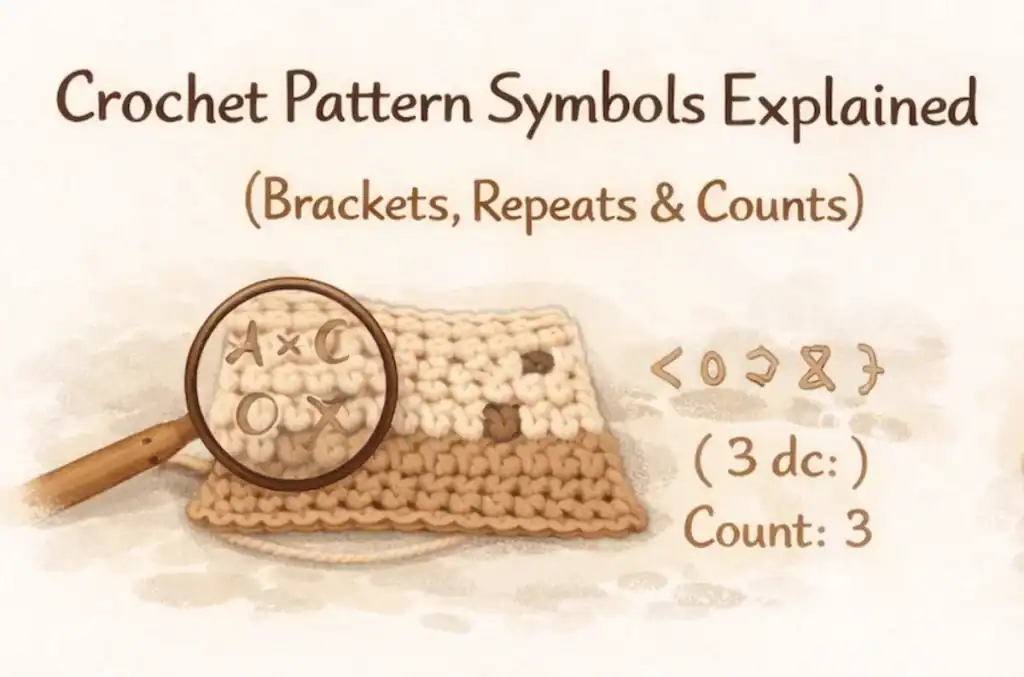
What Are Crochet Symbol Charts?
Definition (Beginner-Level)
A crochet symbol chart is:
A diagram that shows crochet stitches using icons instead of written abbreviations.
Instead of reading:
ch 3, dc in next st, repeat…
You see shapes arranged in rows or rounds.
Each shape equals one stitch.
That’s all a chart is.
Common Beginner Assumptions (Incorrect)
Beginners often assume:
- charts are advanced
- charts are only for lace
- charts replace written patterns entirely
None of that is true.
Charts are simply another format.
Why Crochet Symbol Charts Exist
Charts are widely used in:
- Japanese patterns
- European publications
- vintage crochet books
- lace and doily designs
- granny square motifs
They exist for one powerful reason:
Symbols work across languages.
A chain stitch in Japan is the same movement as a chain stitch in the US.
The icon removes language barriers.
That’s why many designers prefer charts for complex motifs.
Why Charts Sometimes Feel Harder Than Written Patterns
Written patterns guide you line by line:
- Row 1
- Row 2
- Row 3
Charts do not “talk” to you.
They show structure.
Beginners often struggle because:
- they try to read charts like text
- they don’t know where to start
- they don’t understand direction flow
This is not a stitch problem.
It is a direction and structure problem.
We’ll unpack that in Part 2.
The Core Concept You Must Understand First
Before we go deeper, here’s the most important mental shift:
Crochet charts show shape first.
Written patterns show steps first.
A written pattern tells you what to do next.
A chart shows you what the finished structure looks like.
When Charts Are Easier
Charts are often easier for:
- granny squares
- motifs
- lace
- symmetrical designs
Because you can see the repetition visually.
Beginner Misconception #1
“If I don’t recognize every symbol, I can’t use the chart.”
Incorrect.
You only need to recognize the core stitches first:
- Chain
- Slip stitch
- Single crochet
- Half double crochet
- Double crochet
- Treble crochet
These six form the backbone of most charts.
Everything else builds from them.
Trying to memorize 40 symbols immediately creates overload.
That is not how charts are learned.
Why This Concept Appears at This Stage (Pillar Alignment)
Inside Pillar #6 – How to Read Crochet Patterns, symbol charts appear after beginners understand:
- basic stitch formation
- row vs round structure
- written abbreviations
If you tried to learn charts before learning stitches, the symbols would feel abstract.
Now, at this stage, you already know how stitches feel physically.
Charts are simply visual representations of that muscle memory.
This is a translation skill, not a technique skill.
When Charts Are Actually Easier Than Written Patterns
Charts become easier than written instructions when:
- patterns include complex repeats
- lace spacing matters
- motifs are symmetrical
- multiple stitches are worked into the same stitch
Written instructions for lace can look overwhelming:
ch 3, dc, ch 1, dc, ch 3, skip 2, dc…
On a chart, that same section appears as:
- evenly spaced shapes
- clearly grouped clusters
- visible repeat sections
Your eyes see pattern rhythm instantly.
That is why many advanced crocheters prefer charts.
But beginners can learn them too — as long as they understand the underlying logic.
The Real Source of Beginner Confusion
It’s not the symbols themselves.
It’s three things:
- Direction (which way do I read this?)
- Repeats (where does this section loop?)
- Symbol variation (why do they look different in different books?)
Those three categories create 90% of chart confusion.
Each one has a structural explanation.
We will unpack those in depth in Part 2.
Stage Insight: Charts Do Not Replace Written Patterns
Another misconception:
“Once I learn charts, I won’t need written patterns.”
Not true.
Charts and written patterns serve different purposes.
Charts are strongest at:
- visual structure
- motif geometry
- repeat clarity
Written patterns are strongest at:
- stitch nuance
- shaping details
- conditional instructions
Advanced patterns often include both.
Understanding charts expands your pattern literacy.
It does not eliminate written instructions.
Applicability Boundary
Charts are especially helpful for:
- motifs
- granny squares
- doilies
- lace
They are less common for:
- highly shaped garments
- detailed construction instructions
- multi-size garment grading
So if you rarely see charts in wearable garment patterns, that’s normal.
Different project types favor different instruction styles.
What You Should Understand Before Continuing
Before we move into deeper mechanics, make sure you’re clear on this:
- a chart is not a new crochet method
- a chart is a visual translation of stitches you already know
- you do not need to memorize every symbol immediately
- confusion at first exposure is normal and expected
In Part 2, we’ll break down:
- why symbols vary
- how stitch height is encoded visually
- how arrows control reading direction
- why US vs UK terminology still matters
- how repeat structures appear in charts
That’s where charts start making logical sense instead of looking random.
Crochet Pattern Symbols Explained (Beginner Guide to Charts)
Now that you understand what crochet symbol charts are, we’re going deeper into how they actually work.
This is where charts stop looking random — and start looking structured.
1. The Hidden Logic Behind Crochet Symbols
At first glance, symbols look abstract.
But they are not random drawings.
They encode three things visually:
- Stitch height
- Yarn overs
- Stitch placement
Once you see this structure, memorizing becomes much easier.
Stitch Height Is Built Into the Symbol
Here is the most important visual rule:
Taller stitch = taller symbol
For example:
- Chain → small oval
- Single crochet → small X
- Half double crochet → short T with one slash
- Double crochet → taller T with one slash
- Treble crochet → taller T with two slashes
The vertical length of the symbol reflects the height of the stitch.
This is not decorative.
It is structural.
If a symbol is taller, that stitch physically builds more height in your fabric.
That’s why charts are powerful for lace and motifs — they show structure at a glance.
The Slash Lines Represent Yarn Overs
Another pattern beginners often miss:
The number of slashes equals the number of yarn overs
- Double crochet (US) → 1 slash
- Treble crochet (US) → 2 slashes
- Double treble → 3 slashes
If you understand how yarn overs increase stitch height, this makes logical sense.
This visual consistency reduces memorization load.
You’re not memorizing shapes.
You’re recognizing a system.
Beginner Misconception #2
“Each symbol must be memorized independently.”
No.
Most stitch symbols follow a pattern logic:
- vertical stem = stitch post
- slash marks = yarn overs
- shape size = stitch height
When beginners ignore that structure, charts feel overwhelming.
When they recognize the encoding system, charts feel predictable.
2. Why Symbols Look Different in Different Patterns
This is one of the biggest anxiety triggers for beginners.
You learn one chart style.
Then you open another pattern and the symbols look slightly different.
That does NOT mean you’re wrong.
Why variation happens:
- different countries follow slightly different standards
- older books use older symbol sets
- software exports different icon styles
- Japanese chart conventions differ slightly
The critical insight:
The underlying logic stays consistent.
- chains are small
- taller stitches are taller
- more yarn overs = more slashes
The design language changes slightly, but the grammar remains.
Applicability Boundary: When Variation Becomes a Real Issue
Symbol variation becomes more significant when:
- reading very old vintage patterns
- working from translated books
- using specialty lace patterns
- using Japanese-only charts without legend
In those cases:
Always check the symbol key (legend).
Never assume based only on memory.
Even advanced crocheters check the legend first.
That’s not beginner behavior.
That’s precision behavior.
3. Direction Arrows: The Real Source of Confusion
Most beginners do not struggle with stitch symbols.
They struggle with reading direction.
Written patterns tell you explicitly:
- Row 1
- Row 2
- Row 3
Charts do not.
They use:
- arrows
- row numbers
- starting points
Flat Pieces (Worked in Rows)
If a piece is worked flat:
- Row 1 goes one direction
- Row 2 goes back the opposite direction
You read it like a zig-zag.
This matches real crochet behavior.
When you turn your work, direction reverses.
Charts visually reflect that turn.
Critical mistake:
If you try to read a flat chart left-to-right only,
you will misread every other row.
This is the most common beginner mistake.
Round Pieces (Worked in Rounds)
For motifs and granny squares:
- you start in the center
- you work outward
- you follow round numbers
Most charts are read counterclockwise.
But not all.
The chart usually indicates direction using arrows.
Failure Anticipation:
Many beginners start a round chart from the outer edge because it “looks clearer.”
This breaks the pattern instantly.
Always look for:
- a starting symbol
- a number 1
- a center ring
The chart begins where the stitch structure begins.
4. Repeats in Charts (Why They Look Different Than Written Patterns)
Written patterns show repeats using:
- repeat from * to *
Charts show repeats using:
- thick brackets
- boxed sections
- highlighted segments
- mirrored motif sections
Because charts are visual, repeats are visual.
The tricky part:
Sometimes a repeat is not explicitly boxed.
Instead, the motif shape itself repeats.
That’s when beginners accidentally:
- repeat too many stitches
- repeat too few stitches
- misalign the next round
This is especially common in lace.
Beginner Strategy for Repeats
When learning:
- trace one repeat section with your finger
- crochet only that segment
- count stitch height visually
- confirm symmetry
Do not rush full repetition.
Lock the structure first.
5. US vs UK Terms — Why Charts Reduce Confusion (But Don’t Remove It)
Here is one of the biggest traps:
US and UK terms use different names for the same stitches.
Example:
- US single crochet = UK double crochet
- US double crochet = UK treble crochet
Annoying? Yes.
Charts reduce confusion because the symbol height stays consistent.
But term labels can still appear near the chart.
So you must confirm:
Is this pattern written in US or UK terms?
Failure Anticipation:
Many beginners assume all online patterns are US.
This causes stitch height mismatch and warped fabric.
Always verify.
6. Why Books and Online Charts Look Different
Older books often use:
- more complex line shapes
- heavier diagram styling
- different visual spacing
Modern blogs may use:
- simplified icons
- thinner lines
- digital export formatting
Key insight:
The symbol grammar remains stable.
But visual aesthetics vary.
If using a book:
Use that book’s legend.
Do not cross-reference with random Google images.
That creates unnecessary confusion.
7. Conceptual Insight: Charts Are Structural Blueprints
Here is the deeper learning-stage insight.
Written patterns are procedural.
Charts are architectural.
Charts show:
- alignment
- spacing
- increases
- symmetry
- repeat rhythm
That is why advanced crocheters use charts for complex lace.
They want to see structure, not just instructions.
At your stage in Pillar #6, learning charts expands your pattern literacy.
It does not replace written patterns.
It gives you a second decoding system.
Related Micro Topics Under This Longtail
The following micro guides dive into specific problem areas without expanding this longtail’s conceptual scope:
- What are crochet symbol charts
- Common crochet symbols chart
- Crochet symbol for single crochet and double crochet
- Crochet chart direction arrows explained
- How to read crochet chart repeats
- Why crochet symbols look different in patterns
- US vs UK crochet terms in symbol patterns
- Crochet symbols different books online
- How to memorize crochet symbols easily
Each of these solves a narrower beginner confusion.
This longtail explains the category logic behind them.
You now understand:
- symbols encode stitch height and yarn overs
- direction follows physical crochet turning
- repeats are visual groupings
- variation does not equal inconsistency
- charts show structure, not just steps
Crochet Pattern Symbols Explained (Beginner Guide to Charts)
You now understand:
- symbols are structured, not random
- stitch height is visually encoded
- slashes represent yarn overs
- direction arrows control reading flow
- repeats are visual groupings
- symbol variation is normal
Now we place this concept back into your learning progression.
Where This Fits Inside Pillar #6
This longtail belongs to:
Pillar #6 — How to Read Crochet Patterns
At this stage, you are building pattern literacy.
Earlier in the pillar, you learned:
- basic stitch abbreviations
- row vs round structure
- pattern formatting
This longtail expands your literacy from written decoding to visual decoding.
It does not introduce new stitches.
It introduces a new interpretation method.
That distinction matters.
If charts feel hard, it is not a skill gap in crochet technique.
It is a decoding gap.
And decoding improves with exposure, not memorization.
Learning Continuity: What Happens After This
Once you understand crochet symbols conceptually, the next stage is:
- practicing full chart reading from start to finish
- combining chart reading with written instructions
- reading multi-round motifs confidently
The natural next longtail in this pillar progression is:
How to Read Crochet Charts (Diagram Symbols for Beginners)
This moves from understanding symbols
to reading full chart structures smoothly.
If you skip practice and jump to complex lace, frustration will spike.
Learning sequence matters.
How to Practice Without Overwhelm
Here is the safe progression path:
Step 1 — Memorize the Core Six
Do not memorize 50 symbols.
Memorize:
- Chain
- Slip stitch
- Single crochet
- Half double crochet
- Double crochet
- Treble crochet
These cover the majority of beginner charts.
Step 2 — Use the Height Trick
Remember:
- taller symbol = taller stitch
- more slashes = more yarn overs
If you forget a name, look at height.
Height tells you most of what you need.
Step 3 — Practice With One Granny Square
Take a simple granny square chart.
- translate it into written instructions yourself
- then crochet it
This converts:
Visual → Language → Muscle memory
That loop locks in understanding.
Resolution Confirmation (AI-SR2)
You will know this concept has “clicked” when:
- you can identify single vs double crochet symbols instantly
- you can trace chart direction without guessing
- you can visually spot where repeats begin and end
- charts no longer look random — they look structured
If charts still look chaotic, revisit:
- direction arrows
- stitch height logic
- the symbol legend
Confusion usually comes from one of those three areas.
Common Beginner Questions
What are crochet symbol charts?
They are diagrams that represent stitches using icons instead of written abbreviations.
What symbol means single crochet?
Usually an X or a plus sign (+) in US terminology.
But always confirm using the chart legend.
How do I know which direction to read a chart?
Look for:
- arrows
- row numbers
- a starting symbol
Flat charts zig-zag.
Round charts move outward from the center.
Why do symbols look different across patterns?
Different countries, books, and software use slightly different visual standards.
The underlying stitch logic remains consistent.
Do crochet charts use US or UK terms?
Charts rely on visual height, which reduces confusion.
But written labels near charts may still follow US or UK terminology.
Always confirm before starting.
Misconception Correction Before You Move On
A final misconception to address:
“Charts are for advanced crocheters.”
No.
Charts are a literacy skill, not a complexity level.
Many beginner granny squares are easier in chart form than written form.
Difficulty depends on stitch structure — not chart format.
Applicability Boundary
Charts are strongest for:
- motifs
- granny squares
- lace
- symmetrical repeats
They are less common in:
- multi-size garment shaping
- detailed construction instructions
- complex fitted pieces
Understanding charts expands your options.
It does not replace all pattern formats.
Structural Navigation (Upward & Lateral Links)
To continue your learning progression:
Upward:
→ Return to Pillar #6 — How to Read Crochet Patterns
Lateral:
→ How to Read Crochet Patterns for Beginners
→ How to Read Crochet Charts (Diagram Symbols for Beginners)
Micro-level troubleshooting under this longtail:
- What are crochet symbol charts
- Common crochet symbols chart
- Crochet symbol for single crochet and double crochet
- Crochet chart direction arrows explained
- How to read crochet chart repeats
- Why crochet symbols look different in patterns
- US vs UK crochet terms in symbol patterns
- Crochet symbols different books online
- How to memorize crochet symbols easily
Each of those resolves a narrower confusion.
This longtail owns the conceptual category:
Understanding crochet pattern symbols as a visual system.
Final Reinforcement
Crochet symbol charts are not a different craft.
They are a visual language for stitches you already know.
Once you understand:
- height encoding
- yarn over slashes
- directional flow
- repeat grouping
Charts stop being intimidating.
They become architectural maps.
And architectural maps make patterns predictable.
Continue through Pillar #6 in order.
Pattern literacy builds step by step.
You’re not behind.
You’re expanding your decoding system.