Easy Single Crochet Projects for Beginners (7 Simple Ideas That Actually Work)
When beginners search for “easy crochet projects”
Many beginners start learning crochet with one stitch only: single crochet.
That’s completely normal.
Single crochet is usually the first stitch taught after chaining, and for a lot of beginners it’s the only stitch they feel comfortable repeating.
So a very common beginner question becomes:
“Can I make real crochet projects using only single crochet?”
The short answer is yes — and some of the best beginner projects use nothing else.
But not every project built with single crochet is beginner-friendly.
Some projects still require:
- shaping
- complex counting
- sewing multiple pieces
- working in tight rounds
For beginners still learning tension, rows, and stitch recognition, those complications can quickly turn a “simple” project into a frustrating one.
That’s why choosing the right type of single crochet project matters.
- Quick Answer (Beginner TL;DR)
- Why Single Crochet Is the Best Starting Stitch
- Why Some Single Crochet Projects Still Fail for Beginners
- Stage Position in the Crochet Learning Path
- What Makes a Single Crochet Project Beginner-Friendly
- Why Single Crochet Projects Work So Well for Beginners
- The Fabric Mechanics of Single Crochet
- Common Beginner Confusion: Why the Fabric Looks “Different” Each Time
- Why Flat Projects Are the Ideal Starting Point
- Beginner Failure Pattern: The “Amigurumi Trap”
- Applicability Boundary: When Single Crochet Is NOT Ideal
- How Single Crochet Builds Transferable Skills
- Micro Topics Introduced Under This Longtail
- Big Picture Return to the Pillar
- Signs You Are Ready to Move Beyond Single Crochet Projects
- A Simple Beginner Progression Path
- Why Finishing Projects Matters More Than Difficulty
- Related Beginner Questions
- Frequently Asked Questions
- How This Topic Fits into the Crochet Learning System
- Next Learning Step
Quick Answer (Beginner TL;DR)
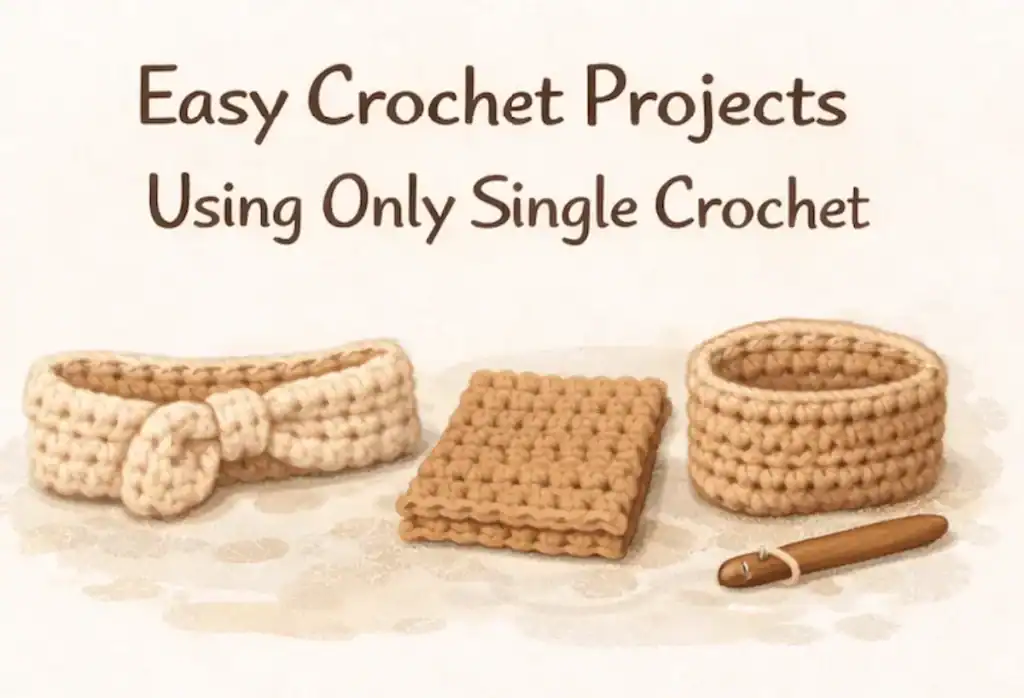
The easiest crochet projects using only single crochet (SC) are:
• dishcloths
• square coasters
• simple scarves
• headbands
• small rectangle pouches
• mug cozies
• basic laptop sleeves
These projects work well for beginners because they are:
✔ flat or rectangular
✔ repetitive
✔ made with beginner yarn like worsted (#4)
✔ free from shaping and sewing
✔ finishable in 1–3 hours
Projects like amigurumi or shaped garments, even if they technically use single crochet, are usually not beginner-friendly first projects.
This concept belongs to: Pillar #7 — Easy Crochet Projects for Beginners
At this stage in the learning path, the goal is not complexity.
The goal is confidence through repetition and completion.
Why Single Crochet Is the Best Starting Stitch
Single crochet works well for beginner projects because it has a very predictable structure.
Each stitch is:
- compact
- easy to identify
- stable in rows
- forgiving with tension mistakes
Compared to taller stitches like double crochet, single crochet produces a dense, firm fabric.
That fabric structure makes beginner mistakes easier to tolerate.
For example:
If tension is uneven, single crochet tends to hide it better than open stitches.
This is one reason many beginner tutorials start with dishcloths or coasters using single crochet rows.
Those projects allow you to practice:
- chaining
- turning
- stitch placement
- counting stitches
- controlling tension
All without introducing additional technical complexity.
Beginner Misconception: “Single Crochet Projects Are Too Basic”
A common misconception beginners have is that single crochet projects are only for practice pieces.
That isn’t true.
Single crochet is widely used in real projects such as:
- bags
- sturdy baskets
- laptop sleeves
- home decor items
- dense winter accessories
The stitch is simple, but the fabric it produces is extremely versatile.
In fact, many experienced crocheters deliberately choose single crochet when they want a durable structure.
For beginners, this means the stitch you’re learning now can remain useful long after the beginner stage.
Why Some Single Crochet Projects Still Fail for Beginners
Another common misunderstanding is assuming that any project using single crochet must be easy.
But the stitch used is only one part of what makes a project beginner-friendly.
Projects can still become difficult when they involve:
- tight spirals in amigurumi
- shaping increases and decreases
- working continuously in rounds
- assembling multiple parts
- complicated counting patterns
For example, many amigurumi toys technically use only single crochet.
However they require:
• precise stitch counting
• shaping increases
• invisible decreases
• sewing limbs
Those additional skills often make them better suited as project #3 or #4, not the very first project.
Understanding this difference helps beginners avoid an early frustration trap.
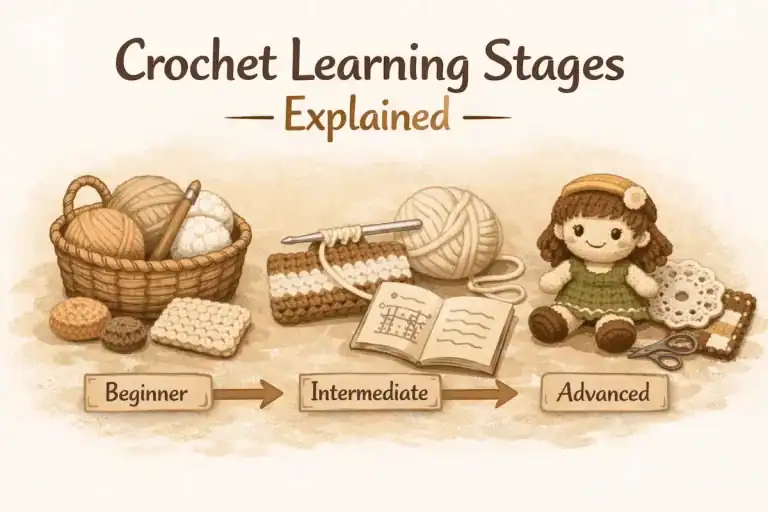
Stage Position in the Crochet Learning Path
Within the beginner crochet learning progression, single crochet projects appear very early.
The typical sequence looks like this:
Stage 1 — Foundation skills
• holding yarn
• making a slip knot
• chaining
• first rows of single crochet
Stage 2 — Confidence projects
• simple rectangles
• repetitive rows
• small finished items
This longtail focuses on Stage 2 projects.
At this stage the objective is simple:
Turn a practice stitch into a finished object.
That psychological shift is important.
When beginners complete even a small object — like a coaster or dishcloth — it proves something powerful:
“I can actually crochet something real.”
That confidence is what allows learners to move forward to more complex stitches and shapes later.
What Makes a Single Crochet Project Beginner-Friendly
Not all single crochet projects are equal.
The best beginner projects share several structural characteristics.
1) Flat construction
The easiest projects are built as squares or rectangles.
Examples:
- dishcloths
- scarves
- simple pouches
- placemats
Flat construction removes the need for shaping or complicated stitch placement.
2) Repetitive rows
Beginners benefit from repetition.
Projects that repeat the same motion help build muscle memory and stitch rhythm.
Single crochet rows provide exactly that.
After several rows, the hand movement becomes automatic.
3) Minimal counting
Projects that require constant stitch math can overwhelm beginners.
Beginner-friendly projects usually involve:
- counting the starting chain
- maintaining consistent row length
But they avoid complicated stitch patterns or repeats.
4) Fast completion time
A project that finishes quickly gives beginners an early success.
For most first projects, the ideal completion time is:
1–3 hours
Small projects provide visible progress quickly, which helps maintain motivation.
Visual Confirmation: How to Recognize a Correct Single Crochet Row
A correctly worked row of single crochet should look like:
- neat V-shaped stitches along the top edge
- rows stacked evenly
- edges forming a straight vertical line
If the edges start slanting outward or inward, that usually means stitches were added or skipped.
This type of mistake is extremely common for beginners.
Fortunately, flat practice projects make it easy to detect and correct.
Failure Anticipation: The Edge Stitch Problem
One of the first issues beginners encounter is losing stitches at the edges.
This happens when the last stitch of the row is accidentally skipped.
The result is a piece that slowly becomes narrower.
Flat projects like dishcloths and scarves help beginners learn to recognize and correct this issue early.
More advanced projects often assume this skill already exists.
By focusing on simple single crochet projects first, beginners develop the control needed before moving on to shaping, stitch patterns, or multi-piece projects.
This is why many learning paths intentionally start with repetitive rectangular objects rather than decorative items.
Why Single Crochet Projects Work So Well for Beginners
Single crochet projects succeed for beginners because the stitch creates a stable learning environment.
Unlike more advanced crochet stitches, single crochet reduces the number of things a beginner must track simultaneously.
A beginner using single crochet mainly focuses on:
• where to insert the hook
• maintaining consistent tension
• completing one stitch motion repeatedly
That simplicity lowers cognitive load.
Instead of juggling multiple technical elements, the learner can concentrate on movement rhythm and fabric structure.
This matters because crochet is ultimately a motor skill.
Your hands must learn the motion before your brain can think about design complexity.
Projects built entirely from single crochet allow that learning process to happen naturally.
The Fabric Mechanics of Single Crochet
Single crochet produces one of the tightest and most compact fabrics in crochet.
Each stitch has a short vertical height, meaning rows stack closely together.
This structure creates three beginner-friendly advantages.
1) Stitch Visibility
Single crochet forms clear V-shaped top loops.
These loops make it easier for beginners to identify:
• where the next stitch should go
• whether a stitch has been skipped
• where the row edge is located
Clear stitch visibility reduces confusion, especially during the first few hours of learning.
2) Structural Stability
Because the stitch is short, single crochet fabric is less stretchy and more rigid than taller stitches.
That stability helps beginners maintain shape in simple projects like:
• coasters
• dishcloths
• pouches
• laptop sleeves
A stable fabric hides minor tension mistakes better than open stitches.
3) Repetition Reinforces Skill
A single crochet row repeats the same movement:
Insert hook → yarn over → pull through → yarn over → pull through.
This repeated motion gradually builds muscle memory.
Once that muscle memory forms, beginners naturally become faster and more confident.
That improvement is why projects built on repetitive rows are so effective during the early learning stage.
Common Beginner Confusion: Why the Fabric Looks “Different” Each Time
Many beginners notice that their early rows of single crochet look uneven.
Some rows may appear:
• tighter
• looser
• slightly slanted
• slightly curved
This is normal.
The reason is tension adjustment.
When beginners first learn crochet, their hands are still experimenting with how tightly to hold the yarn and hook.
During the first few rows, tension changes constantly.
After about 15–20 rows of practice, tension usually stabilizes.
Projects like scarves or dishcloths provide enough repetition for this adjustment period to happen naturally.
Short practice swatches often end before tension stabilizes.
This is why turning the stitch practice into a real object is often more effective than endless small swatches.
Why Flat Projects Are the Ideal Starting Point
Most beginner-friendly single crochet projects are flat rectangles or squares.
This design choice is intentional.
Flat projects eliminate several technical challenges that appear in other crochet forms.
They avoid:
• increasing stitches
• decreasing stitches
• shaping curves
• joining pieces
• spiral rounds
Instead, the project only requires two repeating actions:
Chain → turn → crochet across.
That predictable loop allows beginners to focus on control rather than construction.
Visual Outcome of a Correct Flat Project
When a beginner is crocheting correctly, the project should gradually form a shape that looks like:
• a clean rectangle or square
• straight edges
• rows stacked evenly
If the project starts forming a triangle or trapezoid, the problem is usually stitch count drift.
This means stitches are being accidentally added or skipped.
Flat beginner projects reveal this issue quickly, which is why they are such effective training tools.
Beginner Failure Pattern: The “Amigurumi Trap”
One of the most common beginner mistakes is starting with amigurumi toys.
This happens because many beginner tutorials online feature cute crochet animals.
Most amigurumi patterns use single crochet.
However, the technique involves several additional skills:
• working continuously in rounds
• precise stitch counting
• increases and decreases
• stuffing and shaping
• sewing multiple parts
Even though the stitch itself is simple, the construction complexity is high.
Beginners often become frustrated when their toy ends up:
• uneven
• twisted
• misshapen
This experience can incorrectly convince someone that crochet is difficult.
In reality, the project simply introduced too many new variables at once.
Flat single crochet projects avoid this trap entirely.
Applicability Boundary: When Single Crochet Is NOT Ideal
Although single crochet is excellent for beginner projects, it is not always the best stitch choice.
Some projects benefit from taller stitches such as half double crochet or double crochet.
Examples include:
• lightweight shawls
• lacy garments
• drapey scarves
These projects require more flexible fabric.
Single crochet fabric can sometimes feel too dense for those designs.
However, during the early beginner stage, density is actually beneficial.
Dense fabric helps beginners control shape and recognize mistakes more easily.
How Single Crochet Builds Transferable Skills
A good beginner project should teach skills that apply to future projects.
Single crochet projects build several transferable skills that will remain useful throughout crochet learning.
These include:
• stitch placement accuracy
• consistent yarn tension
• identifying row edges
• maintaining stitch counts
• controlling row alignment
These abilities form the foundation for nearly every crochet technique that comes later.
For example:
When beginners later learn double crochet, the hook insertion and yarn motion feel familiar.
When they attempt granny squares, they already understand stitch structure and spacing.
In other words, single crochet projects are not just beginner practice.
They are skill infrastructure.
Micro Topics Introduced Under This Longtail
This longtail introduces several related beginner questions that are better solved in micro-level guides.
These include:
- Easy Single Crochet Only Projects for Beginners: Start Small
- Beginner Single Crochet Scarf Pattern Ideas: Style with One Stitch
- Simple Single Crochet Dishcloth Pattern for Beginners: A 60-Minute Win
- Single Crochet Baby Blanket for Beginners: The Ultimate Gift
- Easy Single Crochet Bag for Beginners: Fashion Meets Function
- Why Is My Single Crochet Curling? (Causes and Easy Fixes)
- Best Yarn for Single Crochet Projects: Texture and Visibility
Each of these micro topics addresses one specific beginner confusion.
This longtail provides the conceptual explanation, while the micro articles provide focused problem resolution.
Big Picture Return to the Pillar
This guide is part of the beginner project learning system:
Pillar #7 — Easy Crochet Projects for Beginners
The pillar explains the overall learning progression for beginner crochet projects.
This longtail focuses on projects that use only one stitch — single crochet.
Understanding this concept helps beginners choose projects that reinforce early skill development.
Once a learner becomes comfortable with these projects, they can gradually explore:
• projects using multiple stitches
• larger beginner builds
• structured patterns with shaping
This progression allows skills to expand without overwhelming the learner.
The Real Goal of Single Crochet Projects
At the beginner stage, crochet projects serve a different purpose than they do later in the learning journey.
The goal is not complexity.
The goal is skill stabilization.
When beginners repeat single crochet across multiple small projects, they develop three important abilities:
• consistent hand movement
• reliable stitch recognition
• confidence finishing small items
These abilities may seem simple, but they form the core mechanics behind nearly every crochet technique.
Once these mechanics become automatic, learning new stitches becomes significantly easier.
In other words, single crochet projects act as the training ground for all later crochet progress.
Signs You Are Ready to Move Beyond Single Crochet Projects
Many beginners wonder when they should move beyond projects using only single crochet.
A simple indicator is control over rows and edges.
You are likely ready for the next stage when you can consistently:
• maintain the same stitch count across rows
• produce straight edges without narrowing or widening
• recognize the top loops of each stitch easily
• maintain comfortable yarn tension
At this point, your hands understand the basic rhythm of crochet.
The next learning stage often introduces:
• taller stitches such as half double crochet and double crochet
• simple texture patterns
• projects combining two stitches
These techniques build on the foundation created through single crochet practice.
A Simple Beginner Progression Path
A helpful way to structure early crochet learning is to progress through projects that gradually introduce complexity.
A common beginner progression looks like this.
Project 1 — Dishcloth or coaster
Skills developed:
• chaining
• single crochet rows
• turning work
• basic stitch counting
Completion time: 1–2 hours
Project 2 — Simple scarf
Skills developed:
• maintaining long rows
• consistent tension
• straight edges
Completion time: 2–4 hours
Project 3 — Headband or pouch
Skills developed:
• folding simple rectangles
• basic joining or seaming
Completion time: 1–3 hours
Project 4 — Beginner hat or simple blanket
Skills developed:
• working in larger fabric sections
• maintaining consistent structure
By the time beginners complete these projects, they typically feel comfortable experimenting with additional stitches and patterns.
Why Finishing Projects Matters More Than Difficulty
One of the strongest predictors of crochet success is project completion.
Beginners who complete their first few projects quickly tend to remain motivated.
The reason is psychological.
Finishing a project provides visible proof that:
“I can actually make something with crochet.”
Even if the first projects are small — like coasters or dishcloths — they transform crochet from a confusing technique into a productive craft.
This emotional reinforcement is why beginner learning systems emphasize small, finishable projects first.
Related Beginner Questions
Beginners often ask similar questions when they start working on single crochet projects.
These topics are explored in related micro guides.
• What is the best first crochet project for absolute beginners?
• What makes a crochet project beginner-friendly?
• Which beginner projects build confidence the fastest?
• What yarn works best for early crochet projects?
• How long should a first crochet project take?
• What beginner project mistakes should I avoid?
Each of these questions addresses a specific problem beginners encounter during their early learning stage.
Understanding these smaller problems helps reinforce the larger concept explained in this guide.
Frequently Asked Questions
Are single crochet projects too basic for beginners?
No.
Single crochet projects are one of the most effective ways to build early crochet control. Many durable crochet items — including bags and baskets — use single crochet because the fabric is dense and stable.
What is the easiest crochet project using only single crochet?
Square or rectangular projects are the easiest.
Examples include:
• dishcloths
• coasters
• simple scarves
• rectangle pouches
These shapes avoid shaping and complex counting.
Why do my single crochet projects become narrower?
This usually happens when the last stitch of a row is accidentally skipped.
Beginners often miss the final stitch because it sits close to the turning chain.
Counting stitches each row can help prevent this issue.
How do I know if my single crochet tension is correct?
Correct tension usually produces:
• even row spacing
• consistent stitch size
• edges that remain straight
If the fabric curls or becomes stiff, the stitches may be too tight.
If gaps appear between stitches, tension may be too loose.
How This Topic Fits into the Crochet Learning System
This guide belongs to:
Pillar #7 — Easy Crochet Projects for Beginners
Within that system, this longtail explains a specific beginner concept:
Projects that use only one stitch — single crochet.
These projects appear early in the learning journey because they help beginners transform practice stitches into finished items.
Other longtails in the same pillar explore related beginner project categories, such as:
• choosing your first crochet project
• quick crochet projects for beginners
Together, these guides help beginners select projects that match their current skill level.
Next Learning Step
Once you feel comfortable completing projects with single crochet, the next step is to explore fast beginner projects that introduce new skills while still remaining simple.
The next guide in this learning sequence is:
Quick Crochet Projects for Beginners
This topic explores beginner projects designed to be completed quickly while introducing slightly more variety in stitch techniques.
These projects help bridge the gap between basic practice pieces and more structured crochet patterns.
Learning System Reminder
Crochet skills develop best when projects follow a progressive learning path.
Start with small, repetitive builds.
Then gradually introduce:
• new stitches
• slightly larger projects
• simple shaping techniques
This step-by-step approach prevents frustration and makes crochet learning much more enjoyable.
And it all begins with simple projects built from a single stitch.