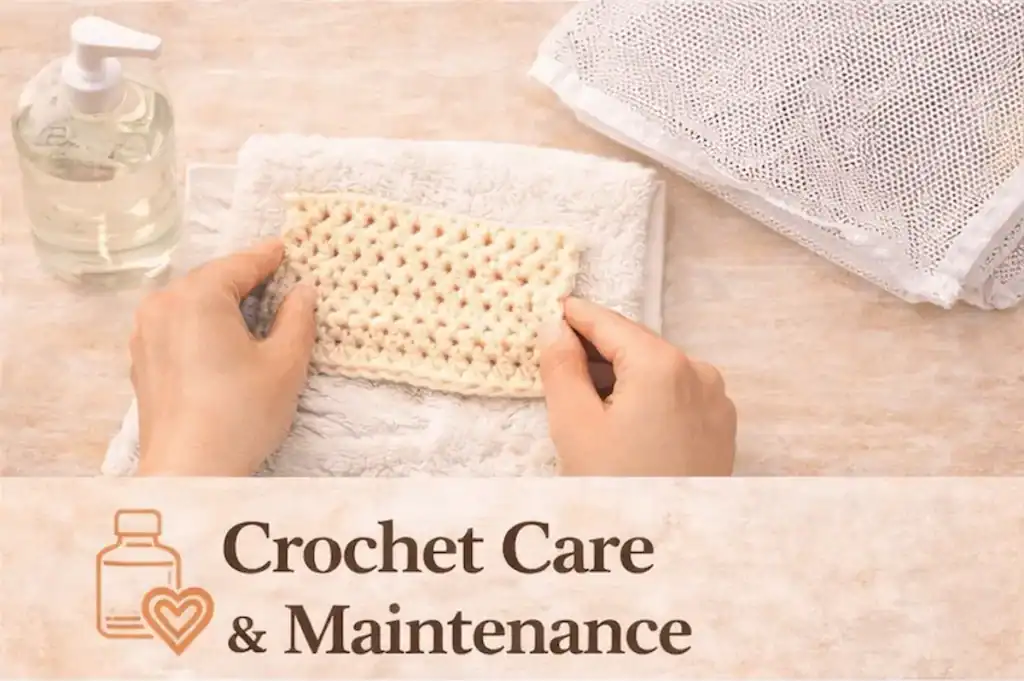
Crochet Care & Maintenance
What Happens After You Finish Crocheting
Most beginner crochet guides end at the same moment:
Fasten off. Weave in ends. Finished.
But in real crochet practice, finishing the last stitch is not the end of the process — it is the beginning of a new phase.
After completion, crochet projects interact with the real world:
- Water Changes Fiber Structure
- Gravity Affects Shape
- Heat Alters Yarn Behavior
- Daily Use Reshapes Fabric Over Time
Beginners are often surprised when a project that looked perfect suddenly changes after washing or wearing.
Edges soften.
Fabric stretches.
Garments fit differently.
This does not mean the crochet was ruined.
It means the project has entered the care and maintenance stage of the crochet lifecycle.
- What Happens After You Finish Crocheting
- The Missing Skill in Beginner Crochet Education
- The Crochet Lifecycle Model
- Why Crochet Changes After Washing
- The Three Core Care Systems
- System 1 — Cleaning
- System 2 — Shape Management
- System 3 — Structural Adjustment (Blocking)
- The Beginner Crochet Care Framework
- Why Fiber Type Changes Everything
- The Beginner Fear Cycle
- How This Pillar Fits Into the Crochet Learning System
- How to Use This Guide
- Why Crochet Care Confuses Beginners
- The Three Most Common Post-Project Surprises
- Why Crochet Behaves Differently From Store-Bought Fabric
- Fiber Behavior: The Hidden Variable
- Why Wet Crochet Is Vulnerable
- The Beginner Overcorrection Problem
- Understanding Temporary vs Permanent Changes
- Why Beginners Misjudge Blocking Results
- Mapping Care Problems to Solutions
- Emotional Normalization: Fear of Ruining Handmade Work
- Transition to Practical Care Skills
- Care Skills Follow a Learning Order
- The Three Stages of Crochet Care Maturity
- Stage 1 — Washing: Cleaning Without Stressing the Fabric
- Hand Wash vs Machine Wash
- Stage 2 — Drying: The Most Critical Step
- Stage 3 — Reshaping: The Adjustment Window
- Stage 4 — Blocking: Intentional Structure Control
- Wet, Steam, and Spray Blocking — Functional Differences
- Fiber-Specific Care Progression
- Fixing Stretching Without Restarting
- When Fixes Have Limits
- The Preventive Care Mindset
- The Preventive Care Model
- Skill Progress Recognition
- Transition to Authority Expansion
- From Care Actions to a Complete Maintenance System
- The Four Authority Pathways of Crochet Care
- The Crochet Care Triangle
- Pathway 1 — Washing Crochet Safely
- Pathway 2 — Understanding Stretching
- Pathway 3 — Fixing Stretched Crochet
- Pathway 4 — Blocking Crochet Projects
- How Longtails and Micros Work Together
- Material Authority Integration
- The Universal Crochet Care Workflow
- Why This System Extends Crochet Lifespan
- Predicting the Next Learning Transition
- Transition to Final Section
- The Crochet Care Navigation System
- Start Here Based on What Happened to Your Project
- The Beginner Crochet Care Checklist
- Progress Recognition: Signs You Understand Crochet Care
- When Maintenance Becomes Prevention
- How This Pillar Maintains Care Authority
- How This Pillar Strengthens the Crochet Learning System
- Crochet as Textile Management Skill
- System Identity: Crochet as a Long-Term Craft
- Continue Your Learning Path
The Missing Skill in Beginner Crochet Education
Crochet learning is usually taught in three stages:
- Learning Stitches
- Completing Projects
- Starting New Designs
A critical fourth stage is often missing:
Maintaining Finished Crochet
Without understanding care, beginners experience unnecessary fear:
- Avoiding Washing Handmade Items
- Believing Stretching Equals Failure
- Misunderstanding Blocking
- Damaging Projects Accidentally
Authority Insight
Care knowledge transforms crochet from decorative craft into functional textile skill.
When learners understand how yarn behaves after completion, confidence increases dramatically.
The Crochet Lifecycle Model
Within the Crochet Hub learning system, every project moves through four phases:
Create → Finish → Care → Preserve
Each phase introduces new knowledge.
| Phase | Primary Skill |
|---|---|
| Create | Stitch Execution |
| Finish | Shaping & Completion |
| Care | Washing & Maintenance |
| Preserve | Long-Term Durability |
This pillar governs the Care phase.
It explains how crochet behaves after leaving the hook.
Why Crochet Changes After Washing
Crochet fabric is flexible by nature.
Unlike woven fabric, crochet contains open loops that respond to environmental forces.
When exposed to water:
- Fibers Relax
- Stitches Settle Into New Positions
- Tension Redistributes
- Weight Increases Temporarily
Predictive Insight
Most beginner panic occurs because crochet looks different before drying, when fibers are at their weakest state.
Understanding this prevents premature conclusions about damage.
The Three Core Care Systems
All crochet maintenance topics fall into three interconnected systems:
- Cleaning — Washing Safely
- Shape Management — Preventing Or Fixing Stretching
- Structural Adjustment — Blocking And Reshaping
These systems form the foundation of this pillar.
System 1 — Cleaning
Cleaning removes dirt and oils but introduces mechanical stress.
Key Variables
- Fiber Type
- Water Temperature
- Agitation Level
- Drying Method
Damage rarely comes from water itself but from movement and weight during washing.
Misconception Correction
Crochet stitches are not fragile. Improper handling while wet causes most problems.
System 2 — Shape Management
Stretching occurs because fibers temporarily lose resistance when wet.
Factors Influencing Stretch
- Yarn Material
- Project Weight
- Stitch Openness
- Drying Position
Authority Clarification
Stretching is often reversible during the drying phase if reshaping occurs early.
Beginners frequently miss this adjustment window.
System 3 — Structural Adjustment (Blocking)
Blocking intentionally reshapes crochet using moisture or heat.
It allows crocheters to:
- Refine Edges
- Even Tension
- Define Stitch Patterns
- Stabilize Finished Dimensions
Blocking is not repair — it is controlled shaping.
Applicability Boundary
Blocking improves appearance but cannot fix fundamental structural errors such as incorrect stitch counts.
The Beginner Crochet Care Framework
This pillar defines the official Crochet Care and Maintenance Framework used within the Crochet Hub.
All post-project situations fall into four maintenance domains:
- Cleaning Exposure
- Moisture Response
- Structural Adjustment
- Long-Term Preservation
Every washing, stretching, reshaping, or blocking question can be positioned inside one of these domains.
This framework replaces guesswork with structured care decisions.
Instead of reacting emotionally to post-wash changes, beginners learn to identify which maintenance domain is active and respond accordingly.
Why Fiber Type Changes Everything
Different yarn fibers respond differently to care.
General Behavior Patterns
| Fiber | Water Response |
|---|---|
| Cotton | Stretches When Wet |
| Wool | Flexible But Sensitive To Heat |
| Acrylic | Heat-Sensitive, Shape-Settable |
| Blends | Mixed Reactions |
Understanding fiber behavior allows predictable maintenance decisions.
Authority Insight
Experienced crocheters think about washing and blocking before starting a project, not after finishing it.
The Beginner Fear Cycle
Many beginners experience the same emotional sequence:
Finish Project → Wash Carefully → Shape Changes → Panic → Avoid Washing Again
This cycle limits real use of handmade items.
This pillar breaks that cycle by explaining why changes occur and how to manage them safely.
Crochet becomes usable when care becomes predictable.
How This Pillar Fits Into the Crochet Learning System
Within the hub architecture:
- Earlier Pillars Teach How To Crochet
- Troubleshooting Pillars Teach How To Fix Mistakes
- This Pillar Teaches How To Protect Finished Work
It connects project completion to long-term durability.
This pillar governs four longtail authority guides:
- How to Wash Crochet Projects Safely
- Why My Crochet Stretched After Washing
- How to Fix Stretched Crochet
- How to Block Crochet Projects
Each expands one maintenance system introduced here.
How to Use This Guide
Navigate based on your current situation:
- If You Are Afraid To Wash A Project → Start With Washing Safety
- If Your Crochet Stretched → Learn Shape Behavior
- If You Want A Cleaner Finish → Explore Blocking
- If You Want Projects To Last Longer → Follow Maintenance Principles
Predictive Guidance
Nearly every crocheter experiences post-wash surprise at least once. Understanding care turns that moment into learning rather than discouragement.
Crochet becomes truly practical when you trust that finished pieces can survive real life.
Why Crochet Care Confuses Beginners
Most beginner crochet problems happen after a project is finished — at the exact moment learners expect difficulty to be over.
A project looks perfect on the hook, but after washing or drying it may suddenly appear different:
- Fabric Becomes Longer
- Edges Soften
- Stitches Look Uneven
- Garments Change Size
- Blankets Feel Heavier Or Looser
Because these changes occur outside the crocheting process, beginners often assume something went wrong.
In reality, crochet care introduces material behavior — a stage of learning separate from stitching skill.
Understanding this landscape removes fear and replaces it with predictability.
The Three Most Common Post-Project Surprises
Across beginner experiences, care-related confusion usually appears in three forms.
1. Washing Anxiety
Many beginners hesitate to wash handmade crochet items.
Common Concerns Include
- Stitches Coming Undone
- Yarn Weakening
- Projects Losing Shape
- Colors Bleeding
This fear exists because crochet feels delicate due to being handmade.
However, crochet fabric is structurally stable when handled correctly.
Misconception Correction
Water itself rarely damages crochet. Improper agitation, heat, or drying position causes most issues.
2. Unexpected Stretching
Stretching after washing is one of the most common beginner panic moments.
- A Scarf Becomes Longer
- A Sweater Feels Looser
- A Blanket Grows Larger
This occurs because water temporarily reduces fiber resistance while increasing weight.
Gravity then pulls on the fabric.
Predictive Insight
Stretching is most noticeable immediately after washing, when fibers are fully relaxed. Many projects recover partially during drying if reshaped properly.
3. Blocking Confusion
Blocking is widely discussed but poorly understood by beginners.
Common Misconceptions Include
- Blocking Fixes All Problems
- Blocking Is Only For Lace
- Blocking Permanently Changes Every Fiber
- Blocking Is Optional Decoration
In reality, blocking is a controlled shaping process with specific purposes and limits.
Authority Clarification
Blocking enhances structure but cannot correct incorrect construction.
Why Crochet Behaves Differently From Store-Bought Fabric
Crochet fabric differs fundamentally from woven textiles.
Woven fabric locks threads tightly together.
Crochet consists of interconnected loops.
This loop structure creates flexibility but also responsiveness to external forces.
| Property | Crochet Fabric |
|---|---|
| Flexibility | High |
| Stretch Potential | Moderate to High |
| Shape Memory | Fiber-Dependent |
| Water Response | Significant |
Because loops move freely, crochet adapts more visibly to washing and drying conditions.
Fiber Behavior: The Hidden Variable
Fiber type determines how crochet reacts to care.
Cotton
- Absorbs Water Heavily
- Becomes Heavier When Wet
- Stretches Easily
- Stabilizes When Dry
Acrylic
- Resists Water Stretch
- Sensitive To Heat
- Shape Can Be Permanently Altered By Steam
Wool
- Elastic And Responsive
- Can Shrink With Agitation
- Blocks Effectively
Applicability Boundary
Blended yarns combine behaviors, making testing on a small swatch especially useful.
Why Wet Crochet Is Vulnerable
Wet crochet is structurally weaker than dry crochet.
During washing:
- Fibers Relax
- Loops Loosen
- Weight Increases Dramatically
Hanging a wet project concentrates weight downward, causing stretching.
Failure Anticipation
Many beginners unintentionally stretch projects by lifting or hanging them while wet rather than supporting the fabric evenly.
Proper drying method often matters more than washing method.
The Beginner Overcorrection Problem
When shape changes appear, beginners often attempt aggressive fixes:
- Wringing Water Out
- Pulling Fabric Into Shape Forcefully
- Applying Excessive Heat
- Repeated Washing Attempts
These actions increase fiber stress.
The correct approach is gradual adjustment during drying or blocking.
Authority Insight
Crochet responds best to gentle guidance rather than forceful correction.
Understanding Temporary vs Permanent Changes
Care-related changes fall into two categories.
Temporary Changes
- Mild Stretching
- Uneven Tension Appearance
- Softened Stitches
Often reversible through drying or blocking.
Permanent Changes
- Heat-Set Acrylic Reshaping
- Severe Fiber Distortion
- Structural Overstretching
These occur when fiber limits are exceeded.
Learning to recognize the difference prevents unnecessary worry.
Why Beginners Misjudge Blocking Results
Blocking changes appearance gradually.
Immediately after blocking:
- Stitches Look More Defined
- Edges Appear Straighter
- Fabric Lies Flatter
Beginners sometimes interpret this as permanent transformation.
In reality, blocking effects vary:
- Wool May Hold Shape Strongly
- Cotton Relaxes Over Time
- Acrylic Retains Shape Only When Heat-Set
Conceptual Clarification
Blocking guides fabric behavior; it does not override fiber properties.
Mapping Care Problems to Solutions
| Problem | Likely Cause | First Action |
|---|---|---|
| Stretched Project | Wet Weight | Reshape While Drying |
| Stiff Fabric | Tight Tension / Residue | Gentle Rinse |
| Uneven Edges After Wash | Drying Position | Flat Drying |
| Floppy Garment | Fiber Relaxation | Blocking |
Diagnosis prevents unnecessary repair attempts.
Emotional Normalization: Fear of Ruining Handmade Work
Beginners often attach emotional value to finished projects.
This makes post-wash changes feel catastrophic.
However, care learning is part of craft mastery.
Nearly every crocheter experiences at least one surprising wash result early in learning.
Authority Insight
Confidence grows when learners realize crochet behavior follows rules rather than luck.
Transition to Practical Care Skills
Now that the beginner care landscape is clear, the next step is learning structured maintenance actions.
The following section explains how washing, drying, reshaping, and blocking form a progression of skills that protect finished crochet over time.
Care Skills Follow a Learning Order
Beginners often treat crochet care as a collection of separate actions:
Wash → Dry → Block → Hope For The Best
In reality, crochet maintenance works as a progressive system where each step prepares the next.
When performed in the correct order, care becomes predictable and safe.
When steps are skipped or reversed, problems such as stretching or distortion appear.
The care progression follows four stages:
- Washing Correctly
- Drying Safely
- Reshaping Intentionally
- Blocking When Needed
The Three Stages of Crochet Care Maturity
Within the Crochet Hub progression, maintenance knowledge develops in three stages.
Stage 1 — Safe Handling
Beginners focus on avoiding damage.
Washing feels risky.
Stage 2 — Controlled Adjustment
Beginners reshape during drying.
Stretching becomes manageable.
Stage 3 — Preventive Planning
Crocheters choose yarn and stitch patterns based on long-term care needs.
Progression Insight
Progression shifts care from reactive correction to proactive design thinking.
Each stage builds on the stability created by the previous one.
Stage 1 — Washing: Cleaning Without Stressing the Fabric
Washing introduces moisture, which temporarily weakens fiber resistance.
The goal of washing is not only cleanliness but controlled exposure to water.
Beginner Washing Principles
Safe washing depends on minimizing mechanical stress:
- Use Cool Or Lukewarm Water
- Apply Gentle Detergent
- Avoid Twisting Or Wringing
- Limit Agitation
Authority Clarification
Crochet stitches rarely fail because of water itself. Damage typically comes from movement while fibers are relaxed.
Hand Wash vs Machine Wash
Hand washing remains the safest beginner method because it allows control over pressure and movement.
Machine washing may be acceptable when:
- Yarn Label Permits It
- Stitches Are Dense
- Ends Are Secured Well
- A Protective Laundry Bag Is Used
Applicability Boundary
Large or delicate crochet items benefit from manual washing even when yarn is technically machine-safe.
Stage 2 — Drying: The Most Critical Step
Drying determines final shape more than washing.
When crochet is wet, gravity becomes the primary shaping force.
Incorrect drying methods create most stretching problems.
Safe Drying Method
- Support The Project Fully
- Roll Gently In A Towel To Remove Excess Water
- Reshape Lightly
- Lay Flat On A Dry Surface
Rule
Never hang wet crochet.
Predictive Insight
Many stretched projects were washed correctly but dried incorrectly.
Drying is the moment where shape decisions occur.
Stage 3 — Reshaping: The Adjustment Window
Reshaping happens while crochet is damp but not dripping.
This phase allows gentle correction of:
- Uneven Edges
- Minor Stretching
- Slight Distortion
Reshaping Techniques
- Smooth Fabric Outward With Hands
- Align Edges Symmetrically
- Measure Dimensions If Necessary
- Adjust Corners Gradually
Failure Anticipation
Waiting until the project is fully dry removes most reshaping flexibility.
The damp stage provides the highest control with lowest risk.
Stage 4 — Blocking: Intentional Structure Control
Blocking formalizes reshaping.
It uses moisture or heat to guide stitches into a desired position.
Blocking is optional for many projects but transformative for others.
Blocking Goals
- Define Stitch Patterns
- Straighten Edges
- Equalize Tension
- Finalize Dimensions
Authority Insight
Blocking refines crochet rather than correcting major mistakes.
Projects that are structurally sound benefit most from blocking.
Wet, Steam, and Spray Blocking — Functional Differences
Wet Blocking
- Fully Soaks Fabric
- Allows Maximum Reshaping
- Best For Natural Fibers
Ideal for cotton and wool projects needing structural adjustment.
Steam Blocking
- Uses Heat And Moisture Without Soaking
- Shapes Fabric Quickly
- Effective For Acrylic With Caution
Heat may permanently set acrylic fibers.
Spray Blocking
- Lightly Moistens Fabric
- Suitable For Small Corrections
- Fastest Method
Best for minor adjustments or maintenance reshaping.
Fiber-Specific Care Progression
Different fibers require different emphasis within the care system.
| Fiber | Priority Stage |
|---|---|
| Cotton | Drying & Reshaping |
| Wool | Washing Temperature Control |
| Acrylic | Heat Management |
| Blends | Gentle Overall Handling |
Understanding fiber behavior prevents overcorrection.
Fixing Stretching Without Restarting
Many stretched projects can be improved without undoing stitches.
Beginner-Friendly Fixes Include
- Reshaping During Drying
- Blocking Edges
- Adding Stabilizing Borders
- Adjusting Storage Methods
Conceptual Clarification
Crochet rarely needs reconstruction. Maintenance adjustments often restore appearance effectively.
When Fixes Have Limits
Some changes cannot be fully reversed:
- Excessive Heat Damage
- Severe Overstretching
- Fiber Breakdown
Recognizing limits protects future projects by improving preventive care decisions.
Authority Insight
Maintenance knowledge reduces future problems more than repair techniques alone.
The Preventive Care Mindset
Advanced beginners begin thinking about care before starting projects.
Questions Include
- What Fiber Am I Using?
- Will This Item Be Washed Often?
- Does The Stitch Pattern Stretch Easily?
- Will Blocking Be Necessary?
Planning care early improves long-term results.
The Preventive Care Model
Preventive care begins before the first stitch.
Consider:
- Fiber Durability
- Expected Washing Frequency
- Project Weight When Wet
- Stitch Openness
- Required Blocking Strength
When maintenance decisions influence design choices, crochet transitions from hobby practice to textile planning.
Preventive thinking reduces future troubleshooting dramatically.
Skill Progress Recognition
You are progressing in crochet care when:
- Washing No Longer Feels Risky
- Drying Becomes Intentional
- Blocking Decisions Feel Purposeful
- Projects Maintain Shape Longer
This marks the transition from crafting objects to managing textiles.
Transition to Authority Expansion
Now that the care workflow is clear, the next section expands outward to connect washing, stretching, fixing, and blocking into the broader Crochet Hub authority structure.
You will see how longtail guides and micro articles provide targeted solutions for specific post-project situations.
From Care Actions to a Complete Maintenance System
Many beginners learn crochet care through isolated advice:
- “Hand Wash Only”
- “Don’t Hang It”
- “You Should Block Your Project”
While helpful, these instructions lack context.
Beginners often do not know when each action applies or why different projects require different treatment.
This pillar expands crochet care into a structured maintenance system where every post-project situation connects to a clear learning pathway.
Instead of memorizing rules, learners understand how washing, stretching, fixing, and blocking relate to one another.
The Four Authority Pathways of Crochet Care
All crochet maintenance knowledge inside the Crochet Hub expands from four core pathways:
- Washing Safely
- Understanding Stretching
- Fixing Shape Changes
- Blocking And Final Shaping
Each pathway corresponds to a longtail authority guide supported by targeted micro solutions.
The pillar defines the system.
Longtails teach concepts deeply.
Micros solve specific real-life problems.
The Crochet Care Triangle
Cleaning, shape behavior, and blocking form a structural triangle.
- If Cleaning Introduces Stress → Shape May Change
- If Shape Changes → Blocking Restores Structure
- If Blocking Is Misunderstood → Cleaning Risks Increase
Understanding this triangle prevents isolated decision-making.
The four longtail guides expand each side of this care triangle while this pillar preserves system-level clarity.
Pathway 1 — Washing Crochet Safely
How to Wash Crochet Projects Safely
Washing introduces the greatest emotional risk for beginners because it feels irreversible.
This pathway teaches how to clean crochet without damaging structure.
Key Learning Outcomes
- Deciding Between Hand Wash And Machine Wash
- Choosing Appropriate Detergent
- Preventing Agitation Damage
- Drying Without Distortion
Micro Guides Address
- Can Crochet Be Machine Washed
- How Often Should Crochet Items Be Cleaned
- What Detergent Works Best
- Should Gifts Be Washed Before Giving
Authority Insight
Safe washing builds confidence to use handmade items in everyday life rather than treating them as fragile decorations.
Pathway 2 — Understanding Stretching
Why My Crochet Stretched After Washin
Stretching is the most common beginner panic moment.
This pathway explains why crochet changes shape after exposure to water.
Core Concepts Include
- Fiber Relaxation
- Gravity Effects On Wet Fabric
- Weight Distribution
- Yarn-Specific Behavior
Learners discover that stretching is usually predictable rather than accidental.
Micro Guides Explore
- Cotton Stretching Behavior
- Acrylic Heat Sensitivity
- Wool Elasticity
- Heavy Project Sagging
Failure Anticipation
Beginners often attempt repairs before understanding causes. Diagnosis reduces unnecessary fixes.
Pathway 3 — Fixing Stretched Crochet
Once stretching occurs, learners need practical recovery strategies.
This pathway introduces corrective methods that avoid undoing work.
Key Solutions Include
- Reshaping While Drying
- Controlled Blocking
- Border Stabilization
- Gradual Structural Correction
Micro Guides Provide
- Fixing Stretch Without Frogging
- Shrinking Safely
- Reshaping Edges
- Recognizing When Fixes Are Limited
Authority Clarification
Repair skills build resilience by showing that most crochet problems are manageable.
Pathway 4 — Blocking Crochet Projects
Blocking represents intentional shaping rather than repair.
This pathway teaches how to refine finished crochet for improved appearance and durability.
Learning Outcomes Include
- Understanding Blocking Methods
- Choosing Wet vs Steam vs Spray Blocking
- Adapting Techniques To Fiber Type
- Deciding When Blocking Is Necessary
Micro Guides Address
- Does Blocking Permanently Change Crochet
- How Long Do Results Last
- Should Blocking Happen Before Or After Washing
- Are Blocking Mats Required
Applicability Boundary
Blocking enhances structure but cannot compensate for incorrect construction or extreme stretching.
How Longtails and Micros Work Together
The DH248 learning structure distributes information intentionally.
| Content Level | Function |
|---|---|
| Pillar | Defines Maintenance System |
| Longtail | Explains Care Concept |
| Micro | Solves Specific Problem |
Example Learning Path
Project Stretched → Micro Explains Cause → Longtail Teaches Fiber Behavior → Pillar Reinforces Maintenance Understanding
This layered structure prevents overwhelm while preserving depth.
Material Authority Integration
Care decisions depend strongly on yarn selection.
Certain fibers require different maintenance expectations.
Supporting Buying Guides
Authority Insight
Durability begins with material choice. Maintenance knowledge connects purchasing decisions to long-term results.
The Universal Crochet Care Workflow
Across all projects, maintenance follows a consistent logic:
Step 1 — Identify Fiber
Fiber determines safe care limits.
Step 2 — Choose Washing Method
Minimize agitation and heat.
Step 3 — Control Drying Shape
Support fabric evenly.
Step 4 — Block if Needed
Refine structure intentionally.
Following this order prevents most beginner care problems.
Why This System Extends Crochet Lifespan
Without maintenance knowledge:
Finish → Wash → Distortion → Disappointment
With structured care:
Finish → Maintain → Reshape → Preserve
Understanding maintenance turns crochet into long-lasting textile work rather than temporary craft output.
Predicting the Next Learning Transition
After learning crochet care, beginners typically experience a major mindset shift:
They begin planning projects based on real-world use.
Questions evolve from:
“How do I make this?”
to
“How will this behave over time?”
This transition leads toward advanced project planning and fiber selection decisions within the Crochet Hub.
Transition to Final Section
The final section consolidates navigation pathways and reinforces this pillar’s role as the long-term preservation center of the crochet learning system.
The Crochet Care Navigation System
Crochet becomes truly practical when finished projects can be cleaned, reshaped, and preserved without fear.
This pillar functions as the post-project navigation center of the Crochet learning system.
Instead of treating washing, stretching, or blocking as emergencies, it provides a clear pathway for handling what happens after a project leaves the hook.
You do not need to remember every care rule.
You only need to identify your current situation and follow the appropriate pathway.
Start Here Based on What Happened to Your Project
Use this guide whenever your crochet changes after finishing.
If You’re Afraid to Wash Your Crochet
Begin with safe cleaning principles.
Go to:
How to Wash Crochet Projects Safely
Focus On
- Fiber Awareness
- Gentle Washing Methods
- Proper Detergent Choices
- Safe Drying Preparation
This stage builds confidence that handmade crochet can survive normal use.
If Your Crochet Stretched After Washing
Move to fiber behavior understanding.
Go to:
Why My Crochet Stretched After Washing
You Will Learn
- Why Water Relaxes Fibers
- How Gravity Affects Wet Fabric
- Which Yarns Stretch More
- How Drying Position Changes Results
Predictive Insight
Most stretched projects improve significantly when reshaped during drying rather than repaired afterward.
If Your Project Already Lost Shape
Focus on recovery techniques.
Go to:
This Pathway Teaches
- Reshaping Methods
- Blocking as Correction
- Border Stabilization
- Realistic Repair Expectations
Understanding limits prevents unnecessary frustration.
If You Want a Professional Finish
Learn intentional shaping.
Go to:
This Stage Explains
- Wet vs Steam vs Spray Blocking
- Fiber-Specific Methods
- When Blocking Is Useful
- How Long Results Last
Blocking transforms finished crochet from handmade appearance to refined textile structure.
The Beginner Crochet Care Checklist
Before washing or blocking any project, ask:
- What Fiber Is This Yarn Made From?
- Is The Project Heavy When Wet?
- Do I Need Cleaning Or Reshaping?
- Can The Fiber Tolerate Heat?
- Should I Test On A Small Swatch First?
If unsure, default to the safest method:
- Cool Water
- Gentle Detergent
- Minimal Handling
- Flat Drying
Authority Insight
Safe defaults protect nearly all beginner projects while experience develops.
Progress Recognition: Signs You Understand Crochet Care
You are advancing beyond beginner uncertainty when:
- Washing No Longer Feels Risky
- You Reshape Projects Automatically While Drying
- Fiber Behavior Becomes Predictable
- Blocking Decisions Feel Intentional
- Finished Items Remain Usable Over Time
Resolution Confirmation
When you trust that your crochet can be washed and maintained safely, your work becomes part of everyday life rather than something stored away.
When Maintenance Becomes Prevention
Experienced crocheters begin thinking about care before starting projects.
You may notice yourself asking:
- Will This Yarn Stretch?
- How Often Will This Item Be Washed?
- Should I Choose A Denser Stitch Pattern?
- Will Blocking Be Necessary Later?
This shift marks the transition from making projects to designing durable outcomes.
Applicability Boundary
No care method prevents all wear. Crochet remains a flexible textile that evolves with use. Maintenance aims for longevity, not permanence.
How This Pillar Maintains Care Authority
All crochet care questions inside the Crochet Hub route through this framework.
Micro articles address specific symptoms:
- Detergent Selection
- Drying Errors
- Heat Damage
- Fiber Reactions
Longtail guides explain complete maintenance concepts.
This pillar preserves system integrity by defining how all care knowledge connects.
How This Pillar Strengthens the Crochet Learning System
Within the Crochet Hub architecture:
- Early Pillars Teach How To Crochet
- Project Pillars Teach Completion
- Troubleshooting Pillars Teach Correction
- This Pillar Teaches Preservation
It closes the learning loop by ensuring finished crochet remains functional over time.
Every post-project situation now connects to a clear solution path:
- Need Cleaning → Washing Pathway
- Shape Changed → Stretching Pathway
- Project Distorted → Fixing Pathway
- Want Refinement → Blocking Pathway
This predictable structure reduces anxiety and increases independence.
Crochet as Textile Management Skill
The Crochet Hub treats crochet as applied textile knowledge, not only stitch execution.
Care and maintenance transform finished crochet from decorative output into durable fabric.
This pillar establishes preservation as a core dimension of crochet mastery.
Creation without maintenance knowledge leaves skill incomplete.
System Identity: Crochet as a Long-Term Craft
Crochet is not only about making objects.
It is about understanding how textiles behave through time, water, movement, and use.
When beginners learn care and maintenance, crochet shifts from a temporary activity into a sustainable craft practice.
Projects stop being fragile accomplishments and become durable handmade items meant for real life.
Continue Your Learning Path
After understanding crochet care and maintenance, continue strengthening your skills through related pillars:
Or explore the longtail and micro guides connected to this pillar whenever a specific care question appears.
Every finished project now has a clear path from creation to preservation.